UK construction VAT reverse charge explained for builders


TL;DR:
The UK construction VAT reverse charge requires customers to account for VAT on certain CIS services instead of suppliers. It applies only when both parties are VAT-registered and the customer is not an end user, with strict invoicing and record-keeping requirements. Failure to comply increases HMRC penalties and can negatively impact small businesses’ cash flow.
The UK construction VAT reverse charge is a VAT accounting mechanism that requires the customer, not the supplier, to account for VAT on eligible construction services. Introduced to combat missing trader fraud in the construction sector, it applies to supplies within the Construction Industry Scheme (CIS) where both parties are VAT-registered. The reverse charge mechanism shifts the VAT reporting obligation away from the subcontractor and onto the main contractor or developer. For construction professionals and small business owners, getting this wrong carries real financial consequences, including HMRC penalties and invoice corrections.
What construction services does the UK VAT reverse charge cover?
The reverse charge applies only to construction services within CIS where both the supplier and the customer are VAT-registered and the customer is not an end user. That last condition is the one most contractors misread.
Covered services include:
Construction, repair, and alteration of buildings and structures
Installation of heating, lighting, air conditioning, and ventilation systems
Demolition and site clearance
Painting and decorating as part of a construction contract
Civil engineering works
Services that fall outside the reverse charge include zero-rated supplies such as new residential builds, professional services like architecture and surveying, and materials supplied separately without any associated construction work. The distinction matters because applying the reverse charge to an excluded service creates an incorrect invoice that HMRC will scrutinise.
An end user is a business or individual that receives construction services for its own occupation or use, not for onward sale. An intermediary supplier is a connected business that buys and resells construction services within the same corporate group. Both categories can opt out of the reverse charge by notifying their supplier in writing. Without that written notification, the default position is that the reverse charge applies.

How to invoice and report VAT correctly under the reverse charge
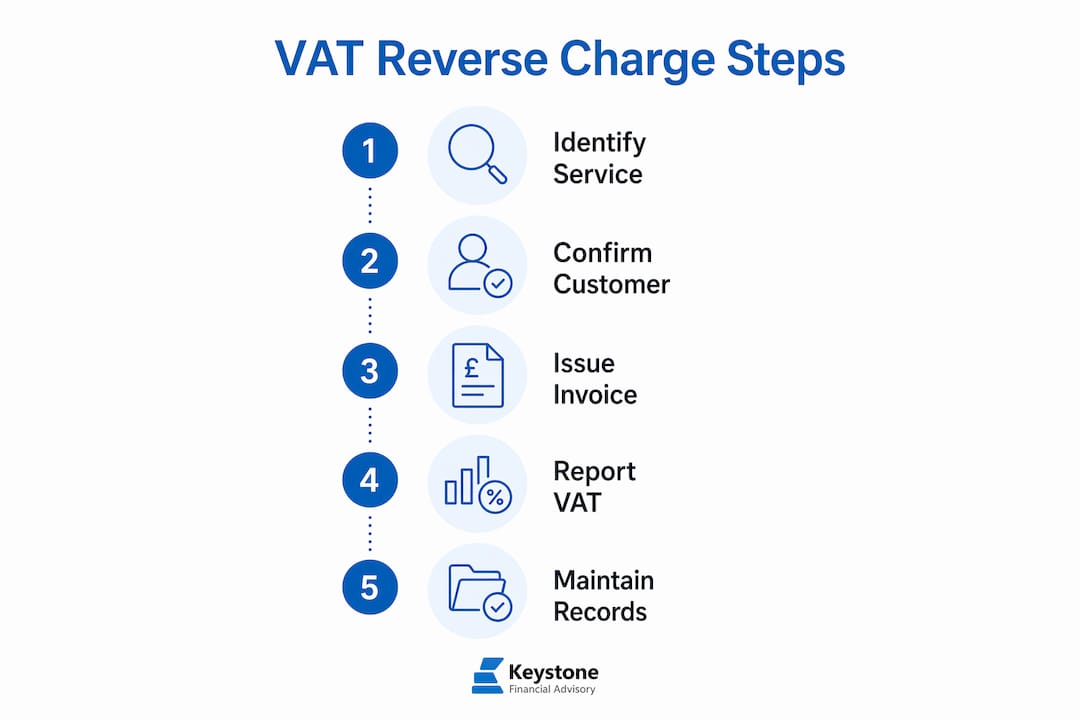
Correct invoicing is where most errors occur. A valid reverse charge invoice must include specific wording such as “Domestic reverse charge: VAT Act 1994, Section 55A applies” and must show the VAT amount for reference only. The VAT is not added to the total payable. The customer receives an invoice showing, for example, a net amount of £10,000 with £2,000 VAT noted but not charged.
The VAT return treatment works as follows:
Supplier (subcontractor): Report the net sale value in box 6 of the VAT return. Do not include output VAT in box 1. No VAT is collected or paid to HMRC on reverse charge sales.
Customer (main contractor): Report the VAT amount as output tax in box 1 and simultaneously reclaim it as input tax in box 4. The net VAT effect is zero for the customer, assuming full VAT recovery.
Record keeping: Maintain written confirmation of the customer’s end-user or intermediary status. This documentation is your primary defence in any HMRC enquiry.
Pro Tip: Ask every new customer to confirm their status in writing before you raise the first invoice. A short email or a signed declaration is sufficient. Store it alongside the contract documents.
If a supplier incorrectly charges VAT when the reverse charge should apply, the customer must not pay the VAT and the invoice must be corrected. Paying incorrect VAT does not protect either party from an HMRC review.
What are the compliance risks and HMRC enforcement trends?
HMRC increased enforcement from 2026, conducting compliance checks and imposing penalties even where no actual VAT revenue was lost to the government. That point surprises many contractors. The absence of a tax loss does not reduce the penalty.
Common errors include:
Applying standard VAT to a reverse charge supply because the customer’s status was not confirmed
Failing to include the mandatory wording on invoices
Incorrectly completing VAT return boxes, particularly boxes 1, 4, and 6
Assuming the Flat Rate Scheme still applies when making only reverse charge supplies
Penalties for careless errors can reach 30% of the VAT due, with deliberate errors attracting penalties up to 100%. Voluntary disclosure before HMRC opens an enquiry reduces the penalty significantly. Once HMRC contacts you first, the reduction available drops sharply.
HMRC’s default assumption is that the reverse charge applies unless written evidence proves end-user status. Suppliers who cannot produce that evidence face the full compliance risk, regardless of what was verbally agreed with the customer.
Maintaining a consistent audit trail with written confirmations and compliant invoices is the most effective way to defend against an HMRC enquiry. Treat every customer status confirmation as a legal document.
How does the reverse charge affect cash flow for small construction businesses?
The cash flow impact is the most underappreciated consequence of the reverse charge for subcontractors. Previously, a subcontractor invoicing £50,000 plus VAT collected £10,000 in VAT from the customer and held it until the next VAT return deadline. That float provided working capital. The reverse charge removes that float entirely, because no VAT changes hands between supplier and customer.
Key cash flow considerations for small construction businesses:
Repayment VAT positions: Subcontractors now frequently find themselves in a VAT repayment position because they pay VAT on materials and overheads but collect none on sales. HMRC processes repayments, but timing can create short-term gaps.
Flat Rate Scheme: Reverse charge supplies are excluded from Flat Rate Scheme calculations, which often eliminates the financial benefit of the scheme for subcontractors. Businesses should review whether remaining on the scheme makes sense.
Forecasting: Update cash flow forecasts to reflect the removal of VAT receipts from projected inflows. Many small firms have been caught short by treating VAT receipts as available cash.
Pro Tip: If you are regularly in a VAT repayment position, consider switching to monthly VAT returns. HMRC processes monthly repayments faster than quarterly ones, which improves your actual cash position.
The financial management challenges created by the reverse charge require proactive planning. Waiting until the VAT return deadline to discover a cash shortfall is avoidable with the right bookkeeping setup.
Common pitfalls and best practices for staying compliant
Getting the reverse charge right consistently requires process, not just knowledge. The most common pitfall is treating customer status as a one-time check. Customer circumstances change. A business that was an end user on one project may not be on the next.
Best practices include:
Verify VAT registration status for every customer on every new contract, using HMRC’s online VAT number checker
Obtain written end-user confirmation before raising any invoice, and refresh it for each new project
Train your accounts team or bookkeeper on the correct VAT return boxes and invoice wording
Review your accounting software settings to confirm it handles reverse charge invoices correctly
If an error is discovered, correct it promptly through a credit note and reissued invoice, and consider voluntary disclosure to HMRC
For small business owners managing their own accounts, the business structure you operate under can also affect how VAT obligations interact with other tax liabilities. Taking professional advice before errors compound is always less costly than correcting them after an HMRC letter arrives.
Key takeaways
The UK construction VAT reverse charge shifts VAT accounting to the customer, removes VAT cash flow from subcontractors, and carries significant HMRC penalties for errors, making accurate invoicing and written customer status confirmation non-negotiable.
Point | Details |
Reverse charge scope | Applies to CIS services where both parties are VAT-registered and the customer is not an end user. |
Invoice wording | Must state “VAT Act 1994, Section 55A applies” and show VAT for reference only, not in the total payable. |
VAT return boxes | Suppliers report net sales in box 6 only; customers report output tax in box 1 and reclaim in box 4. |
Cash flow impact | Subcontractors lose the VAT float; monthly VAT returns can speed up repayments and ease cash gaps. |
Penalty exposure | Careless errors attract penalties up to 30% of VAT due; voluntary disclosure before HMRC contact reduces this. |
My view on where construction firms are getting this wrong
From working with construction clients across the UK, the single biggest compliance failure I see is not the invoicing. Most contractors have updated their invoice templates. The real problem is the absence of a documented process for confirming customer status at the start of each contract. Firms rely on memory or assumption, and that is where HMRC finds its opening.
The 2026 enforcement increase has changed the risk profile significantly. HMRC is no longer treating reverse charge errors as administrative oversights. They are treating them as compliance failures, and the penalty calculations reflect that. I have seen businesses face assessments on supplies where no VAT was ever at risk of being lost to fraud, simply because the paperwork was not in order.
My advice is straightforward. Build a one-page checklist into your contract onboarding process. Confirm VAT registration, confirm end-user status in writing, and file both documents with the contract. That single habit removes the majority of your compliance exposure. If you are unsure whether a particular supply falls within the reverse charge, get advice before you raise the invoice, not after.
— Shoaib
VAT compliance support for construction businesses
Construction firms managing VAT reverse charge obligations alongside CIS deductions, payroll, and project accounting face a genuinely complex compliance picture.
[

](www.keystonefa.co.uk)
KeystoneFA works with contractors and small construction businesses across the UK to get VAT compliance right from the start. The team handles reverse charge invoicing reviews, VAT return preparation, and HMRC correspondence, so you are not left guessing when the rules change. KeystoneFA’s advisers have hands-on experience with construction VAT compliance and can identify cash flow risks before they become problems. If your VAT position has changed since the 2026 enforcement increase, a review with KeystoneFA is a practical next step.
FAQ
What is the UK construction VAT reverse charge?
The UK construction VAT reverse charge is a mechanism under VAT Act 1994, Section 55A, where the customer accounts for VAT on eligible CIS construction services instead of the supplier. It applies when both parties are VAT-registered and the customer is not an end user.
Does the reverse charge apply to all construction work?
No. It applies only to CIS-covered services between VAT-registered businesses where the customer is not an end user. Zero-rated supplies, professional services, and separately supplied materials are excluded.
What happens if I charge VAT incorrectly on a reverse charge supply?
The customer must not pay the incorrectly charged VAT, and the invoice must be corrected. HMRC may open a compliance review regardless of whether any VAT revenue was actually lost.
How does the reverse charge affect the Flat Rate Scheme?
Reverse charge supplies are excluded from Flat Rate Scheme calculations, which typically removes the financial benefit of the scheme for subcontractors who make mainly reverse charge sales.
How do I confirm a customer’s end-user status?
Request written confirmation from the customer before raising the invoice. HMRC’s default assumption is that the reverse charge applies, so written evidence of end-user status is the only reliable protection for the supplier.
Recommended