How UK landlords can reduce their tax bill in 2026
- KeystoneFA
- Jul 12
- 7 min read


TL;DR:
UK landlords can lower their tax bills by claiming all allowable expenses and choosing suitable ownership structures.
Section 24 limits mortgage interest relief to a 20% tax credit, especially affecting higher-rate taxpayers.
UK landlords reduce their tax bill primarily through three routes: claiming all allowable revenue expenses, applying the Section 24 mortgage interest tax credit, and choosing the right ownership structure for their circumstances. HMRC’s rules on property income tax are specific, and missing even one deductible expense category costs landlords real money each year. Making Tax Digital (MTD), which becomes mandatory for most landlords from april 2026, adds a fourth dimension to effective tax planning. This guide covers each strategy in practical terms, with the 2026 rules applied throughout.
How can UK landlords reduce their tax bill through allowable expenses?
The single most accessible way to reduce rental income tax is to claim every allowable revenue expense against your rental profit. HMRC applies the “wholly and exclusively” test: an expense must be incurred entirely for the purpose of your letting business to qualify.
Allowable deductions in 2026 include a wide range of costs that landlords regularly overlook:
Letting agent fees and property management charges
Buildings and contents insurance premiums
Council tax and utility bills paid during void periods
Garden upkeep and routine maintenance
Accountancy fees and legal fees for tenancies under one year
Travel mileage to inspect or manage your properties
The distinction between revenue expenses and capital expenses is where many landlords go wrong. Revenue expenses reduce income tax immediately, whereas capital expenses, such as a loft conversion or a new extension, do not reduce rental income tax. Capital costs may reduce your capital gains tax bill when you eventually sell, but they offer no relief against annual rental profits.
A common pitfall is claiming a full kitchen renovation as a repair. Replacing like-for-like is a revenue expense. Upgrading to a higher specification is a capital improvement. HMRC draws this line firmly, and getting it wrong triggers enquiries.

Mortgage arrangement fees deserve a specific mention. They count as finance costs under Section 24 and must be claimed in the year paid, not spread across the mortgage term. Many landlords miss this and lose the relief entirely.
Pro Tip: Keep a dedicated folder, physical or digital, for every receipt and invoice related to your properties. HMRC can request evidence going back several years, and a well-organised record saves both money and stress during any compliance review.
How does Section 24 affect mortgage interest tax relief?
Section 24 is the single biggest tax change to affect individual landlords in a generation. Fully in force since 6 April 2020, it removed the right to deduct mortgage interest directly from rental profits. Instead, landlords receive a 20% basic-rate tax credit on their total finance costs.
The credit is capped at the lowest of three figures:
Total finance costs paid in the year
Rental profit for the year
Taxable income above the personal allowance
For a higher-rate taxpayer with £10,000 in annual mortgage interest, the old system gave £4,000 of tax relief (40%). Section 24 now gives only £2,000 (20%). That £2,000 annual difference compounds significantly across a portfolio of properties.
This is why Section 24 hits higher-rate and additional-rate taxpayers hardest. A basic-rate landlord with no mortgage debt feels little impact. A higher-rate landlord with significant borrowing can find their effective tax rate on rental income rising sharply, sometimes to the point where a property generates a cash profit but a tax liability simultaneously.
Limited companies remain exempt from Section 24 and can still deduct mortgage interest in full before calculating corporation tax. This exemption is the primary driver behind the surge in landlords considering incorporation.
Pro Tip: Model your Section 24 position using your actual mortgage interest figures and marginal tax rate before making any structural decisions. The numbers often tell a different story to the headlines.
What ownership structures help landlords cut their tax bills?
The choice between personal ownership and a limited company structure is the most consequential tax decision a landlord makes. There is no universal answer. The right structure depends on your income tax band, your level of mortgage debt, and whether you plan to reinvest profits or extract them as income.
Factor | Personal ownership | Limited company |
Mortgage interest relief | 20% tax credit only (Section 24) | Full deduction before corporation tax |
Income tax on profits | 20%, 40%, or 45% depending on band | Corporation tax at current rates |
Profit extraction | Taxed as rental income directly | Subject to dividend tax when withdrawn |
Best suited to | Basic-rate landlords, low or no mortgage | Higher-rate landlords reinvesting profits |
Incorporation decisions hinge on five variables: your marginal tax rate, mortgage interest owed, profit reinvestment plans, leverage level, and unrealised capital gains on existing properties. Dividend tax can offset the corporation tax savings, particularly for landlords who need to draw income regularly rather than retain it within the company.
Transferring existing properties into a limited company also triggers Stamp Duty Land Tax and potentially Capital Gains Tax on the transfer. These upfront costs mean incorporation only makes financial sense over a longer time horizon for most landlords.
Pro Tip: Before incorporating, run a full five-year financial model comparing both structures. A sole trader vs limited company comparison that includes transfer costs, dividend tax, and mortgage refinancing costs gives you a far clearer picture than a simple rate comparison.
How does Making Tax Digital affect landlord tax planning?
Making Tax Digital for Income Tax is not just a compliance requirement. Used well, it is a tax planning tool. MTD starts in april 2026 and requires landlords to keep digital records and submit quarterly updates to HMRC through compatible software, replacing the single annual Self Assessment return.
The quarterly submission deadlines are 7 august, 7 november, 7 february, and 7 may. Missing these triggers automatic penalties, and the fines accumulate quickly across a full tax year.
The practical steps for compliance are straightforward:
Choose HMRC-compatible software before the april 2026 start date.
Set up digital records for each property separately.
Diarise all four quarterly submission deadlines at the start of each tax year.
Reconcile income and expenses monthly rather than annually.
Use each quarterly submission as a checkpoint to review your tax position.
Most landlords who struggle with MTD delay adoption and face a data backlog when deadlines arrive. Early adopters benefit from cleaner records, more accurate expense claims, and the ability to spot tax-saving opportunities mid-year rather than after the fact.
Pro Tip: Treat each quarterly MTD submission as a mini tax review. If your rental profit is tracking higher than expected, you have time to bring forward deductible expenditure before the year ends.
Key takeaways
Proactive tax planning, not year-end fixes, is the most effective way for UK landlords to reduce their tax bill across every stage of property ownership.
Point | Details |
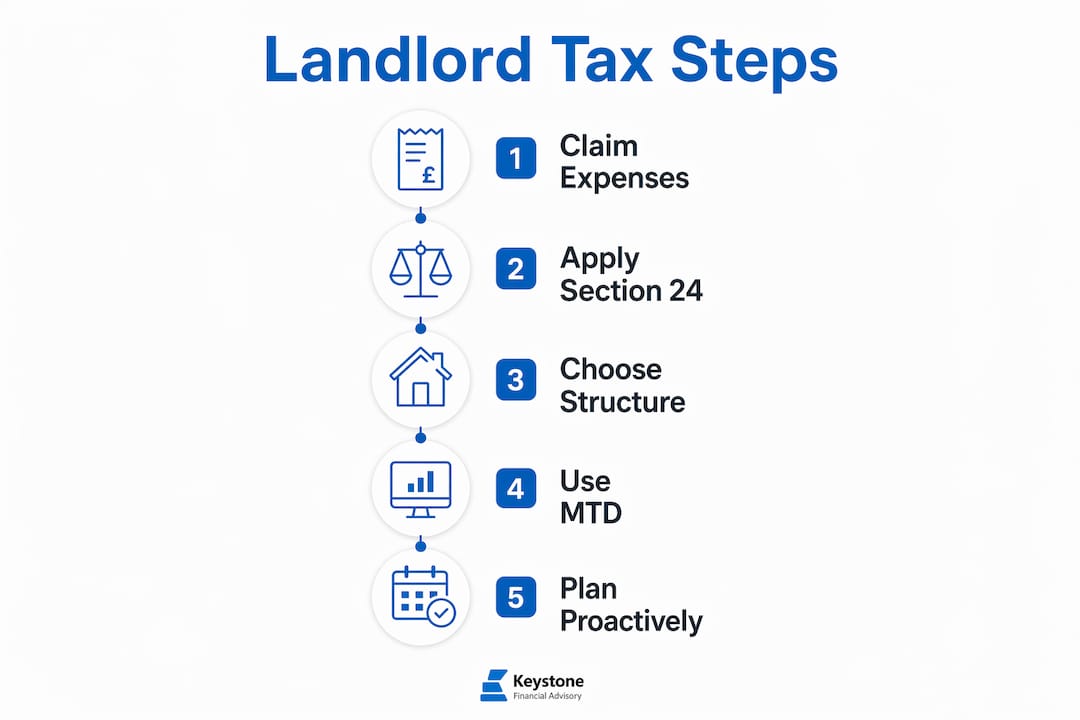
Claim all allowable expenses | Include letting fees, insurance, void-period costs, and accountancy fees to reduce taxable rental profit. |
Understand Section 24 | Higher-rate landlords receive only a 20% tax credit on mortgage interest, not a full deduction. |
Choose the right structure | Limited companies suit higher-rate landlords reinvesting profits; personal ownership suits basic-rate landlords with low debt. |
Prepare for MTD now | Set up HMRC-compatible software before april 2026 and diarise all four quarterly deadlines. |
Plan proactively | Model post-2027 tax changes now rather than reacting at year-end to avoid costly surprises. |
What I have learned from working with landlords on tax planning
Most landlords I work with come to us after a painful Self Assessment bill, not before it. That pattern is the core problem. Proactive tax planning at the purchase and income forecasting stages consistently delivers better outcomes than any year-end scramble.
The ownership structure question is the one that keeps me busy. Landlords often read a headline about limited companies saving tax and assume incorporation is the right move for them. The reality is more nuanced. I have seen landlords pay more tax after incorporating because they did not account for dividend tax on profit withdrawals or the Stamp Duty cost of the transfer. The maths only works in your favour under specific conditions.
My honest observation is that the landlords who pay the least tax are not the ones with the most complex structures. They are the ones who keep meticulous records, claim every legitimate expense, and review their position at least quarterly. MTD will force that discipline on everyone from 2026 onwards. The landlords who build those habits now will find the transition straightforward and their tax bills lower as a result.
— Shoaib
How KeystoneFA supports landlords with tax planning
Reducing your tax bill as a landlord requires more than knowing the rules. It requires applying them accurately to your specific portfolio, income level, and long-term goals.
[

KeystoneFA works with UK landlords to identify every allowable deduction, assess whether a limited company structure makes financial sense, and prepare for MTD compliance before the april 2026 deadline. The team brings experience from top UK and Middle East firms, and every client receives a personalised approach rather than a generic checklist. Whether you need a one-off tax consultation or ongoing quarterly support, KeystoneFA provides the depth of advice that makes a measurable difference to your rental returns. Book a consultation to review your current tax position and identify where you can save.
FAQ
What expenses can UK landlords deduct from rental income?
Landlords can deduct letting agent fees, insurance, maintenance costs, void-period council tax, accountancy fees, and legal fees for short tenancies. Capital improvements such as extensions are not deductible against rental income.
How does Section 24 affect higher-rate landlords?
Section 24 replaces full mortgage interest deduction with a 20% basic-rate tax credit. Higher-rate taxpayers lose up to half their previous mortgage interest relief, which significantly increases their effective tax rate on rental profits.
Is a limited company better for landlords than personal ownership?
A limited company suits higher-rate landlords who plan to reinvest profits, as it allows full mortgage interest deduction before corporation tax. Personal ownership remains more tax-efficient for basic-rate landlords with little or no mortgage debt.
When does Making Tax Digital start for landlords?
MTD for Income Tax starts in April 2026. Landlords must keep digital records and submit quarterly updates to HMRC through compatible software, with deadlines on 7 August, 7 November, 7 February, and 7 May each year.
Can landlords claim mortgage arrangement fees under Section 24?
Yes. Mortgage arrangement fees count as finance costs and qualify for the Section 24 tax credit. They must be claimed in the tax year they are paid, not spread across the mortgage term.
Recommended