Claiming home office expenses through a UK limited company


TL;DR:
Claiming home office expenses through a UK limited company involves choosing a method that meets tax rules and maintains proper documentation. The three recognized approaches are the flat-rate allowance, actual costs, and rental agreements, each suited to different spending levels and administrative efforts. Post-2026, companies must reimburse directors directly, with unreimbursed claims no longer qualifying for tax relief.
Claiming home office expenses through a UK limited company is defined as the process by which a director reimburses themselves, via their company, for the additional household costs incurred while working from home. HMRC permits this under Corporation Tax rules, provided costs meet the “wholly and exclusively” test for business use. Three recognised methods exist: the flat-rate allowance, actual additional household expenses, and a formal rental or license agreement. Getting this right matters more than ever, as 6 April 2026 changes have tightened how unreimbursed relief can be claimed.
What are the main methods for claiming home office expenses through a limited company?
Three broad methods cover virtually every director’s situation when it comes to home office tax relief in the UK. Each carries different evidence requirements, tax implications, and levels of administrative effort.
Flat-rate allowance: The company pays you £6 per week as an allowable expense. No receipts are needed and there are no PAYE or National Insurance Contributions implications.
Actual additional household expenses: The company reimburses a calculated proportion of your real running costs, such as heating, electricity, and broadband. You need bills and a defensible apportionment method.
Rental or license agreement: You formally rent part of your home to your limited company. The company deducts rent as a business expense, and you declare the income on your Self Assessment return.
The right method depends on how much you genuinely spend and how much paperwork you are willing to maintain. Directors with modest costs often prefer the flat rate. Those with a dedicated home office and higher bills benefit from claiming actual costs or setting up a rental agreement.
Pro Tip: Assess your actual monthly utility bills before defaulting to the flat rate. If your additional costs clearly exceed £26 per month, the actual expenses method will save you more Corporation Tax.

How does the flat-rate allowance method work?
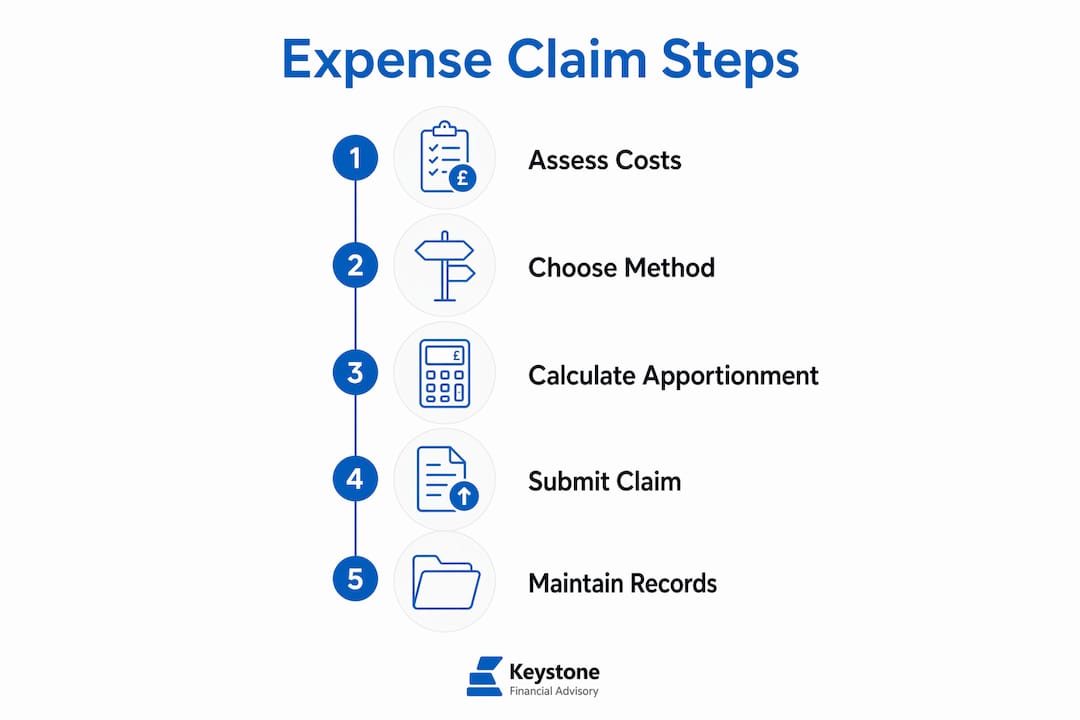
The £6 per week flat-rate allowance is the simplest route for limited company directors working from home. It amounts to £312 per year and is an allowable deduction against Corporation Tax. No receipts are required, which removes most of the administrative burden.
The company processes the payment directly to the director. Because the allowance reflects genuine homeworking costs rather than a benefit, it carries no PAYE or NIC implications when handled correctly. That distinction matters: process it incorrectly through payroll and HMRC may treat it as employment income.
Confirm you regularly work from home for business purposes.
Have the company pay you £6 per week via a director’s expense claim.
Record the payment in the company’s accounts as an allowable business expense.
Retain a note of the working-from-home arrangement in your company records.
The flat rate does have a ceiling. If your actual additional costs are higher, the allowance under-represents what you spend. Experts advise that directors should assess whether actual costs exceed the flat rate and be prepared to substantiate higher claims with proper documentation.
Pro Tip: Post-2026, unreimbursed claims by employee-directors are disallowed. The company must pay you directly. A simple monthly expense claim form keeps this clean and audit-ready.
How to claim actual additional household expenses
Claiming a proportion of real household running costs gives directors a larger deduction when genuine costs are higher than £312 per year. The key requirement is that expenses must be wholly and exclusively for business, with dual-purpose costs requiring a defensible apportionment method.
The types of costs you can include are:
Heating and electricity
Broadband (the business-use portion only)
Home insurance (the business-use portion)
Repairs to the specific area used for work
Water rates (in some cases, where business use is identifiable)
Apportionment is calculated by dividing costs based on the number of rooms in the property and the hours spent working. For example, if you have eight rooms and use one exclusively for work, you can claim one-eighth of relevant costs. You then apply a time fraction if the room is not used solely for business.
Cost type | Claimable? | Apportionment basis |
Electricity and heating | Yes | Rooms used and hours worked |
Broadband | Partial | Business vs personal use split |
Home insurance | Partial | Business use proportion |
Mortgage interest | Generally no | Capital cost, not revenue |
Council Tax | Generally no | Personal liability |
Certain costs with significant personal use, such as home internet, require a consistent and reproducible calculation method. HMRC expects the same approach year-on-year. Ad-hoc figures invite challenge during a compliance check.
The company reimburses the director for the calculated amount. That reimbursement is then deducted from the company’s taxable profits, reducing the Corporation Tax bill. Keep all bills, calculations, and reimbursement records for at least six years.
What is the rental or license agreement approach?
A rental or license agreement is the most tax-efficient method for directors with a dedicated home office space. The company pays you rent for the exclusive use of part of your home. That rent is an allowable business expense for the company, reducing its Corporation Tax liability.
Directors should treat the arrangement as a genuine commercial contract, with clear terms covering the space used, the rental amount, and maintenance responsibilities. HMRC scrutinises informal arrangements, so documentation is not optional.
Key points to address in the agreement:
Clearly identify the room or area rented to the company
State the monthly rental amount at a commercial rate
Specify that the space is used exclusively for business purposes
Include notice periods and review clauses
“Directors renting part of their home to their limited company should treat the arrangement commercially with documented license terms, clear office use, and prepare for personal tax consequences.”
You must declare the rental income on your personal Self Assessment tax return. The income may be partially offset by allowable expenses such as a proportion of mortgage interest or repairs. Be aware that renting part of your home to your company can affect your Capital Gains Tax position when you sell the property, as that portion may lose its Private Residence Relief. Consulting a tax adviser before setting up the agreement is the sensible step. You can also read about tax-efficient withdrawals from your limited company to understand how rental income fits into your overall extraction strategy.
Common mistakes and compliance tips
The most frequent error directors make is claiming household costs without any apportionment. HMRC does not accept claims for the full cost of a utility bill simply because you work from home. Every claim needs a calculation that separates business use from personal use.
Post-2026, companies must reimburse costs directly to claim Corporation Tax relief. Unreimbursed claims by employee-directors are no longer valid. This means the payment must flow from the company to the director, not remain as an unclaimed personal expense.
Practical steps to stay compliant:
Keep all utility bills, broadband invoices, and insurance documents
Document your apportionment method and apply it consistently each year
Maintain payroll records and receipts as back-up for reimbursed costs
Review your method annually, especially if your working pattern changes
Seek professional advice if your costs are complex or your home office arrangement is unusual
You may also find it useful to review expenses directors often overlook to make sure you are not missing other legitimate deductions alongside your home office claim.
Pro Tip: Store your apportionment spreadsheet alongside your annual accounts. If HMRC opens an enquiry, a clear, consistent calculation is your strongest defense.
Key takeaways
Claiming home office expenses through a UK limited company requires choosing the right HMRC-recognised method, applying a consistent apportionment approach, and ensuring the company reimburses costs directly to comply with post-2026 rules.
Point | Details |
Three recognised methods | Flat-rate allowance, actual household expenses, and rental or licence agreement each suit different situations. |
Flat rate is £6 per week | The £312 annual allowance requires no receipts but may under-represent actual costs for many directors. |
Apportionment is mandatory | Dual-purpose costs like broadband must be split between business and personal use using a consistent method. |
Post-2026 reimbursement rule | Companies must pay directors directly; unreimbursed personal claims no longer qualify for Corporation Tax relief. |
Rental agreements need documentation | A formal license with commercial terms protects the claim and clarifies personal tax obligations on rental income. |
What I have seen directors get wrong most often
Working with limited company directors on their expense claims, the pattern I see most is this: directors assume that because they work from home, all household costs are fair game. They are not. The “wholly and exclusively” test is strict, and HMRC applies it seriously.
The rental agreement route is underused. Many directors are put off by the paperwork, but a well-drafted license agreement is straightforward and often produces a meaningfully larger tax saving than the flat rate. The personal tax on rental income is usually modest when offset against allowable costs, and the company’s Corporation Tax saving can be substantial.
My honest advice is to match the method to your actual situation. If you have a spare room used only for work and a mortgage, the rental route deserves a proper look. If you share a kitchen table with your family, the flat rate is honest and defensible. Complexity for its own sake creates risk. Simplicity, backed by evidence, is what survives an HMRC enquiry.
— Shoaib
How KeystoneFA helps directors claim home office costs correctly
Getting home office expenses right is not just about saving tax. It is about doing so in a way that holds up under scrutiny. KeystoneFA works with limited company directors across the UK to identify the most appropriate claim method, set up compliant documentation, and keep records audit-ready.
[

KeystoneFA’s team has direct experience with HMRC compliance requirements, including the 2026 changes affecting homeworking relief. Whether you need a one-off tax consultation to review your current approach or ongoing support with your company accounts, KeystoneFA provides clear, practical guidance without the jargon. Book a consultation online to discuss your home office claim and ensure your limited company is extracting every legitimate deduction available.
FAQ
Can a limited company pay for home office expenses?
Yes. A limited company can reimburse a director for home office costs using the flat-rate allowance, actual additional household expenses, or a formal rental agreement. The reimbursement must come directly from the company to qualify for Corporation Tax relief under post-2026 rules.
What is the £6 per week home office allowance?
The £6 per week allowance is an HMRC-recognised flat rate that limited companies can pay directors for working from home. It totals £312 per year, requires no receipts, and carries no PAYE or National Insurance implications when processed correctly.
Do I need receipts to claim home office expenses through my limited company?
The flat-rate method requires no receipts. Claiming actual household expenses does require bills, invoices, and a documented apportionment calculation to satisfy HMRC’s “wholly and exclusively” test.
Does renting my home office to my limited company affect Capital Gains Tax?
Renting part of your home to your company can reduce your Private Residence Relief on that portion when you sell the property. A tax adviser should review the arrangement before you sign any license agreement.
What changed for home office claims from April 2026?
From 6 April 2026, employee-directors can no longer make unreimbursed personal claims for homeworking costs. The company must reimburse the director directly for costs to claim Corporation Tax relief. Directors who previously claimed relief personally through Self Assessment need to update their approach.
Recommended