Can mortgage interest be fully deducted in a UK property company?


TL;DR:
A UK property company can fully deduct mortgage interest against rental income before paying corporation tax.
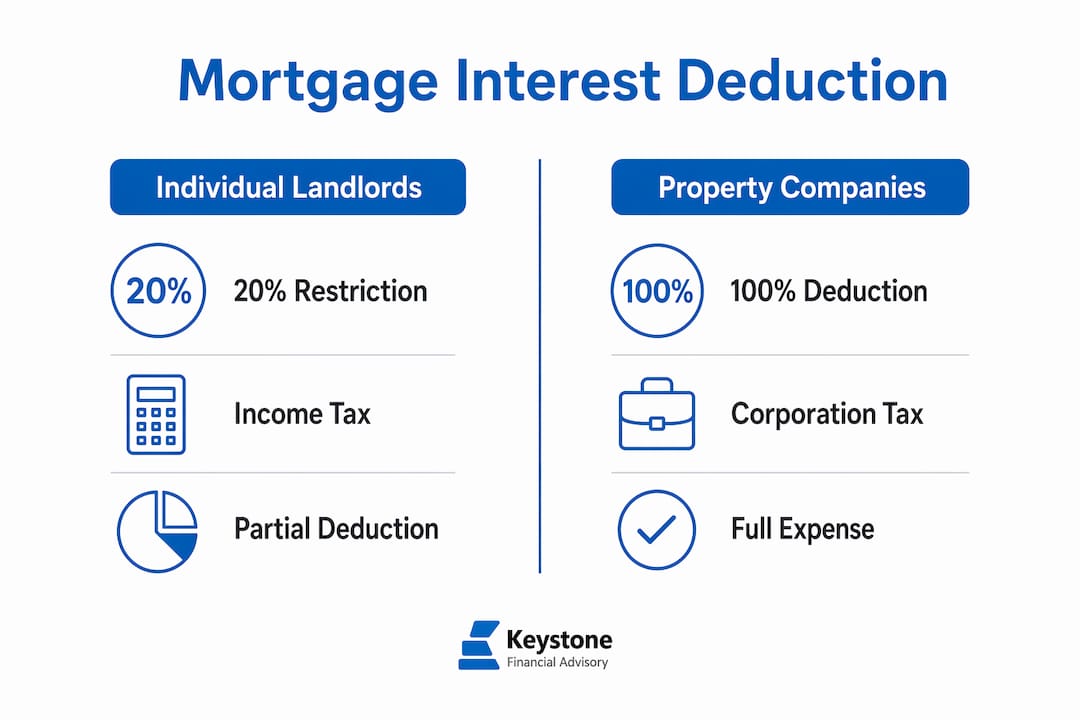
This contrasts with individual landlords, who face restrictions under Section 24 that limit interest deductions to a basic-rate tax credit.
A UK property company can deduct 100% of its mortgage interest as a legitimate business expense against rental income before corporation tax is calculated. This is the single most important tax distinction between owning property through a limited company and owning it personally. Individual landlords have faced the Section 24 restriction since april 2020, which replaced full interest deduction with a basic-rate tax credit worth just 20% of finance costs. For higher and additional-rate taxpayers, that change was costly. Understanding how mortgage interest deductibility works inside a property company is now central to any serious UK property tax strategy.

Can mortgage interest be fully deducted in a UK property company?
Yes. Limited companies are fully exempt from the Section 24 mortgage interest restriction. A property company deducts its mortgage interest directly from rental income, reducing the taxable profit on which corporation tax is charged. That is a full deduction, not a credit.
Section 24 is strictly an income tax rule for individuals and partnerships. Companies pay corporation tax, which sits under an entirely different legislative framework. The Corporation Tax Act 2009, Part 4 governs how property income is calculated for companies, and it treats mortgage interest as an ordinary finance cost, deductible in full.
The contrast is stark. An individual landlord paying £12,000 per year in mortgage interest receives a tax credit of £2,400 (20% of £12,000). A property company paying the same interest deducts the full £12,000 from its rental profit before any tax is applied. For a higher-rate taxpayer, the personal route costs significantly more.
Pro Tip: If you are a higher or additional-rate taxpayer with significant mortgage interest costs, the Section 24 restriction alone can make incorporation worth modelling. The numbers often surprise people.
What the law actually says
The Section 24 restriction applies only to individuals and partnerships subject to income tax. It does not appear anywhere in corporation tax legislation. HMRC’s own guidance confirms that Section 24 does not apply to companies, which follow corporation tax rules and deduct finance costs in full. This is not a loophole. It is the intended legislative design.
What mortgage costs can a property company deduct?
Mortgage interest is the headline deduction, but it is not the only finance cost a property company can claim. Understanding the full list matters when calculating the company’s actual tax position.
Deductible mortgage-related expenses include:
Mortgage interest payments: Deducted in full against rental income each accounting period.
Mortgage arrangement fees: Typically spread over the life of the loan using the effective interest rate method, though immediate deduction may apply in some cases.
Remortgaging costs: Fees paid to switch lenders or restructure finance are deductible as revenue expenses.
Bridging loan interest: Interest on short-term finance used for property acquisition or refurbishment is deductible where the loan relates to the company’s property business.
One critical boundary: capital repayments are never tax deductible, in either personal or corporate ownership. Only the interest element of a mortgage payment reduces taxable profit. Paying down the loan principal has no tax benefit.
Pro Tip: Directors often forget that arrangement fees are a deductible expense. If you paid a fee to set up a company mortgage, check whether your accountant has spread it correctly across the loan term. Missed deductions are money left on the table. The KeystoneFA guide on forgotten director expenses covers this in detail.
How does incorporation affect your overall tax position?
The full interest deduction is powerful, but it operates within a broader tax picture. Corporation tax on property company profits ranges from 19% on profits up to £50,000 to 25% on profits above £250,000, with marginal relief applied between those thresholds. That compares favourably with individual income tax rates of up to 45% for additional-rate taxpayers.
The table below shows how the two structures compare on key tax variables.
Tax variable | Individual landlord | UK property company |
Mortgage interest treatment | 20% basic-rate tax credit only | Full deduction against rental income |
Tax rate on rental profit | 20%, 40%, or 45% income tax | 19%–25% corporation tax |
Dividend tax on profit extraction | Not applicable | 8.75%–39.35% depending on rate band |
Capital Gains Tax on disposal | 18% or 24% residential CGT | Corporation tax rate plus SDLT on transfer |
The table makes the company structure look attractive, and for many landlords it is. The catch is profit extraction. Profits retained inside the company are taxed at corporation tax rates. Profits taken out as dividends face an additional layer of dividend tax. A landlord who needs rental income to live on will pay more in total tax than the headline corporation tax rate suggests.
Company mortgages also typically carry higher interest rates, often 0.5% to 1.5% above equivalent personal buy-to-let rates, with lower loan-to-value ratios available. That higher borrowing cost partially offsets the tax saving from full interest deductibility. The net benefit depends on the specific numbers for each property and landlord.
Practical pitfalls to avoid when deducting mortgage interest
Deciding to use a property company for mortgage interest deductions requires more than a tax calculation. Several practical and legal requirements apply, and getting them wrong can invalidate the deduction entirely.
The company must be the legal borrower. The company, not the individual director, must be legally liable for the mortgage. If a director takes out a personal mortgage and lends the money to the company, the interest deduction sits with the individual, not the company. The mortgage must be in the company’s name.
Payments must be recorded correctly. Mortgage interest must appear as a finance cost in the company’s accounts. Sloppy bookkeeping that mixes personal and company finances can trigger HMRC scrutiny and disallow the deduction.
Incorporation triggers Stamp Duty Land Tax. Transferring existing personally held properties into a company is treated as a sale at market value. SDLT applies on that value, and the individual may also face Capital Gains Tax on any gain. These one-off costs can take years to recover through tax savings.
Model the break-even point before acting. The break-even analysis for incorporation involves your marginal income tax rate, total mortgage interest, planned investment horizon, and CGT implications on eventual sale. There is no universal answer. The right structure depends entirely on your specific numbers.
Take professional advice before any transfer. The decision between sole trader and limited company structures has long-term consequences that are difficult to reverse without significant cost.
Key takeaways
A UK property company can deduct mortgage interest in full against rental income, making it a materially more tax-efficient structure than personal ownership for landlords affected by Section 24.
Point | Details |
Full deduction for companies | Property companies deduct 100% of mortgage interest before corporation tax is applied. |
Section 24 does not apply | Section 24 is an income tax rule; companies pay corporation tax and are entirely exempt. |
Arrangement fees are deductible | Mortgage arrangement fees are spread over the loan life and reduce taxable profit. |
Capital repayments are not deductible | Only the interest element of a mortgage payment qualifies as a deductible expense. |
Incorporation has upfront costs | SDLT and potential CGT on transfer can take years to recover through tax savings. |
My view on mortgage interest deductions and property companies
The full deduction is genuinely significant. I have seen landlords with large mortgage books save tens of thousands of pounds per year by holding properties through a company rather than personally. For a higher-rate taxpayer with substantial finance costs, the Section 24 restriction is punishing, and the company route addresses it directly.
That said, I am cautious about treating this as a simple win. The landlords who benefit most are those who do not need to extract all their profits immediately. If you are living off your rental income, the dividend tax layer erodes the advantage considerably. The landlords who benefit least are those with modest mortgage interest, low profits, or properties they plan to sell soon. The SDLT and CGT costs on incorporation can easily exceed several years of tax savings.
The accounting requirement is also underestimated. The company must be the legal borrower, payments must be correctly recorded, and the accounts must be prepared accurately for the CT600 return. These are not burdensome tasks with the right support, but they are real obligations that add cost and complexity.
My honest recommendation: run the numbers properly before making any decision. A proper scenario analysis comparing personal and company ownership over your intended holding period is the only way to know whether incorporation makes sense for your situation.
— Shoaib
How KeystoneFA can help with your property tax structure
Property tax decisions carry long-term consequences, and the mortgage interest question is rarely straightforward in practice.
[

KeystoneFA works with UK property owners and company directors to model the real tax impact of different ownership structures. The team handles everything from corporation tax returns and CT600 filings to SDLT planning and CGT analysis on property transfers. If you are weighing up whether a property company makes sense for your portfolio, or you already hold properties through a company and want to confirm your mortgage interest is being claimed correctly, KeystoneFA’s advisory team can give you a clear, numbers-based answer. Personalised advice from experienced professionals makes the difference between a good decision and an expensive one.
FAQ
Does Section 24 apply to limited companies?
No. Section 24 applies only to individuals and partnerships subject to income tax. Limited companies pay corporation tax and can deduct mortgage interest in full.
Can a property company deduct mortgage arrangement fees?
Yes. Mortgage arrangement fees are a deductible expense for a UK property company. They are typically spread over the life of the loan rather than claimed in full in the year they are paid.
Are capital repayments on a mortgage tax deductible?
No. Capital repayments are never deductible in either personal or corporate ownership. Only the interest portion of a mortgage payment reduces taxable profit.
What corporation tax rate applies to a property company’s rental profits?
Corporation tax rates range from 19% to 25% depending on profit level. The 19% rate applies to profits up to £50,000, and 25% applies above £250,000, with marginal relief between those thresholds.
Does the company need to hold the mortgage in its own name?
Yes. The company must be the legal borrower for the interest to be deductible as a company expense. A personal mortgage used to fund a company property does not qualify for the company deduction.
Recommended