Claiming meals and subsistence through your UK limited company

TL;DR:
Claiming meals and subsistence through a UK limited company is permitted only when expenses are wholly for travel to a temporary workplace. HMRC’s benchmark rates allow tax-free meal reimbursements between £5 and £25, depending on the trip duration, without needing receipts. Only genuine business travel, not personal or commuting trips, qualifies for subsistence claims under strict rules.
Claiming meals and subsistence through your UK limited company is allowed under HMRC rules, but only when the expense is wholly and exclusively for business travel to a temporary workplace. The industry term for these claims is “subsistence expenses,” covering food and drink costs incurred during qualifying business journeys. HMRC sets clear conditions, benchmark scale rates, and documentation requirements that every director and employee must follow. Get it right and you reduce your company’s tax bill compliantly. Get it wrong and you risk a tax investigation.
Can I claim meals and subsistence through my UK limited company?
Yes, but the qualifying conditions are specific. Meals can only be claimed when you are travelling to a temporary workplace, not when commuting to your regular office or working from home. A temporary workplace is any location you attend for a limited duration or purpose, rather than as your ordinary place of work.
HMRC defines two key absence thresholds that trigger allowable subsistence claims:
5 hours away from your normal workplace: the minimum absence for a meal claim to qualify.
10 hours away: a longer absence that unlocks a higher allowance.
Travel must have begun before the meal is purchased. You cannot buy lunch at home before leaving and then claim it.
Free meals are excluded. If your accommodation or travel package includes meals, you cannot claim separately for food.
Alcohol is not claimable. HMRC excludes alcoholic drinks from all subsistence allowances.
Daily commuting does not qualify. Travelling from home to your permanent office is never a subsistence claim, regardless of distance.
A practical example makes this clear. If you drive from London to a client site in Birmingham for a full day meeting and buy lunch on the road, that meal qualifies. If you pop out for lunch near your usual office, it does not.
How do HMRC benchmark scale rates work?

HMRC’s benchmark scale rates are fixed, tax-free allowances that simplify how limited companies reimburse meal costs during qualifying business travel. Standard benchmark meal allowance rates for 2026 are as follows:
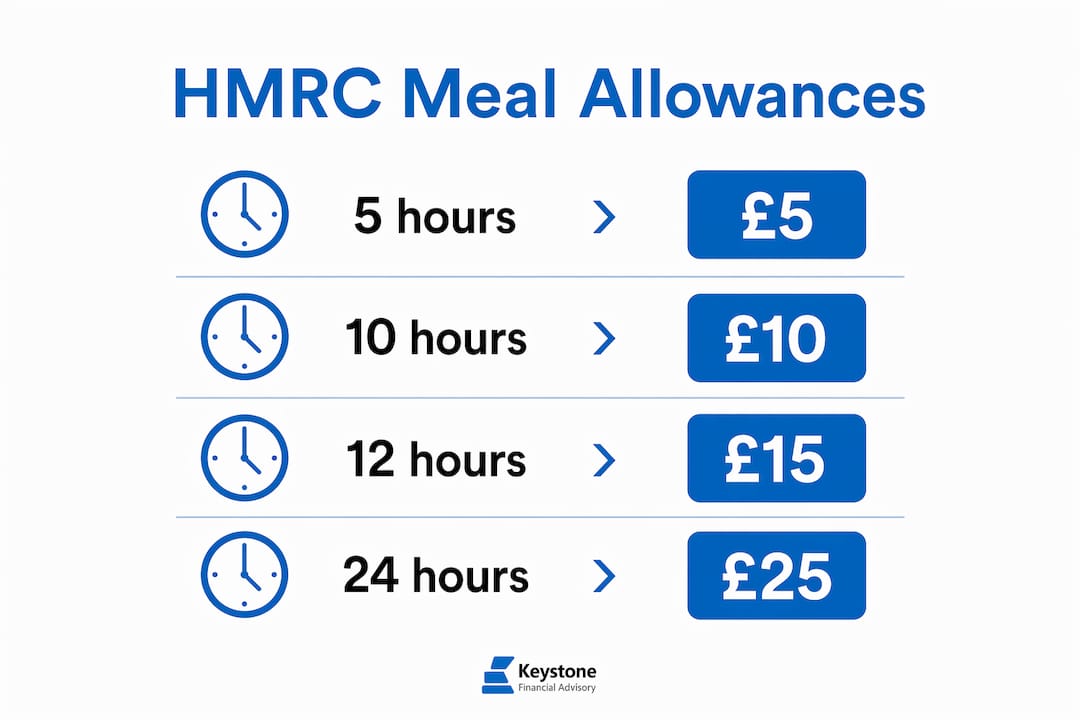
Trip duration | Benchmark meal allowance |
5 hours | £5 |
10 hours | £10 |
12 hours | £15 |
24 hours or longer | £25 |
These rates are tax-free for the employee or director receiving them, provided the qualifying journey conditions are met. That means no income tax and no National Insurance contributions on the reimbursement, up to the published limit.
Receipts are not required to pay at benchmark rates, but you still need evidence that the qualifying journey took place. Employers must maintain checking systems such as travel logs or expense records to confirm entitlement. The absence of a food receipt does not mean the absence of all paperwork.
Paying above the benchmark rate without a formal agreement with HMRC creates a tax problem. Excess payments over published scale rates are subject to income tax and National Insurance liabilities. That extra £5 above the rate is no longer tax-free.
Pro Tip: If your employees regularly spend more than the benchmark rates, apply to HMRC for bespoke scale rates. A formal application supported by a sample-based study of actual costs can set higher tax-free limits and remove the need for detailed receipt-keeping on every minor purchase.
Can directors and employees claim all meal expenses?
The short answer is no. The “wholly and exclusively” principle governs every subsistence claim. Meal expenses wholly and exclusively for business can be claimed by limited company directors, but entertainment costs are not allowable. This distinction catches many directors out.
Taking a client to lunch is entertainment, not subsistence. Client meals are generally treated as business entertainment and are non-allowable for corporation tax purposes. You pay for the meal through the company, but the company gets no tax relief on it. Many directors assume any meal with a business contact is claimable. It is not.
Mixed-purpose trips create another common problem. If you combine a three-day business trip with two days of personal holiday, you must apportion costs strictly to cover only the days of genuine business activity. Meals on personal days are personal expenses, full stop.
Common mistakes that attract HMRC attention include:
Claiming meals eaten at home before or after a business trip.
Claiming social meals with colleagues as subsistence.
Treating client entertainment as a subsistence expense.
Failing to separate personal and business days on combined trips.
Claiming meals during the daily commute to a permanent workplace.
Pro Tip: Keep a brief note on every expense record stating the business purpose of the journey. One sentence is enough. “Client meeting, Manchester, 14 june 2026” is far more defensible than a bare receipt with no context.
Directors should also check legitimate expenses they may be missing, since subsistence is just one category of allowable costs that often goes unclaimed.
What records do you need to keep for meal expense claims?
Good record-keeping is the difference between a clean HMRC enquiry and a costly one. The documentation requirements for subsistence claims are straightforward but non-negotiable.
Keep receipts for actual meal purchases. Even when using benchmark rates, receipts support the overall audit trail.
Maintain a travel log. Record the date, destination, purpose, and duration of every qualifying journey.
Note the business purpose. A brief description of the meeting or work activity confirms the trip was not personal.
Use an expense report system. Submit claims through a consistent process, whether that is a spreadsheet, accounting software, or a dedicated expenses platform.
Report correctly on your Company Tax Return. Allowable subsistence reduces your corporation tax bill. Non-allowable entertainment does not.
Meal allowances paid within HMRC benchmark rates do not require reporting on P11D forms. That removes a significant administrative burden, provided you stay within the published limits and meet the qualifying conditions.
If your team’s actual costs consistently exceed benchmark rates, apply to HMRC for bespoke scale rates. A formal application with a sample-based expense study can establish custom tax-free limits. This is one of the most underused tools available to UK limited companies, and it can significantly reduce the receipt-keeping burden across your workforce.
Keeping thorough business records protects you not just on subsistence claims but across every area of your company’s tax position.
Key takeaways
Subsistence expenses are allowable through a UK limited company only when the journey is to a temporary workplace, the absence meets HMRC’s minimum thresholds, and the expense is wholly and exclusively for business.
Point | Details |
Qualifying conditions are strict | Travel must be to a temporary workplace, with at least 5 hours away from the usual place of work. |
Benchmark rates simplify claims | HMRC allows tax-free meal payments of £5–£25 depending on trip duration, without requiring food receipts. |
Entertainment is not subsistence | Client meals are non-allowable for corporation tax; only genuine travel subsistence qualifies. |
Mixed trips need apportionment | Only meals on genuine business days are claimable; personal days must be excluded from any claim. |
Bespoke rates are available | Companies with higher actual costs can apply to HMRC for custom scale rates to reduce receipt-keeping. |
Subsistence claims: what I have seen go wrong (and right)
The most common mistake I see from directors is treating any meal bought outside the office as a business expense. The HMRC definition of subsistence is tighter than most people assume. It is not about where you eat. It is about why you are away from your normal workplace and for how long.
The bespoke scale rate option is genuinely underused. Most business owners either do not know it exists or assume the application process is too complex. It is not. If your team regularly travels and spends more than £10 or £15 per day on food, the application pays for itself quickly in reduced tax liability and simpler administration.
Mixed-purpose trips are where I see the most audit risk. A conference in Barcelona with a weekend extension is a legitimate business trip combined with a personal holiday. But you must be able to show, clearly and in writing, which days were which. HMRC does not give the benefit of the doubt on this. The burden of proof sits with you.
My honest advice: do not avoid claiming legitimate subsistence out of caution, and do not overclaim out of optimism. The rules are clear enough to follow precisely. If you are unsure whether a specific trip or meal qualifies, get a tax consultation before you file, not after.
— Shoaib
How KeystoneFA supports your limited company expense claims
Subsistence rules sit at the intersection of employment tax, corporation tax, and HMRC compliance. Getting the details right matters, and the cost of errors adds up quickly across a year of business travel.
[
KeystoneFA works with UK limited company directors and founders to review expense claim policies, identify allowable subsistence costs, and apply for bespoke scale rates where standard HMRC benchmarks fall short. The team brings hands-on experience with HMRC compliance across a wide range of business sizes and sectors. Whether you need a one-off expense claim review or ongoing support with your company’s tax position, KeystoneFA offers the kind of direct, personalised advice that larger firms rarely provide. Book a consultation to get clarity on what your company can legitimately claim.
FAQ
What counts as a temporary workplace for subsistence claims?
A temporary workplace is any location you attend for a limited period or specific purpose, rather than as your regular place of work. HMRC distinguishes it from a permanent workplace, where daily commuting costs are not allowable.
Do I need receipts to claim HMRC benchmark meal rates?
Food receipts are not strictly required at benchmark rates, but you must keep travel records confirming the qualifying journey took place. Employers must maintain checking systems such as travel logs to confirm entitlement.
Are client meals tax-deductible for a UK limited company?
No. Meals with clients are treated as business entertainment and are non-allowable for corporation tax purposes. Only genuine subsistence during business travel qualifies for tax relief.
What happens if I pay above the HMRC benchmark rates?
Payments above the published scale rates without a bespoke agreement are taxable. The excess is subject to income tax and National Insurance contributions for the recipient.
Can a sole trader use the same benchmark rates as a limited company?
No. Sole traders claim actual subsistence expenses with receipts rather than using HMRC per diem benchmark rates. The benchmark scale rate system applies specifically to employers reimbursing employees or directors.
Recommended