How to reduce your UK corporation tax bill legally


TL;DR:
Claiming all allowable expenses, maximizing capital allowances, and timing pension contributions reduce UK corporation tax legally.
Careful record-keeping and strategic purchase timing are essential for claiming reliefs and avoiding penalties.
The most effective way to reduce your UK corporation tax bill legally is to claim every allowable expense, maximise available capital allowances, and plan your profit and remuneration timings with HMRC’s rules in mind. Tax avoidance schemes carry serious penalties. Legitimate tax reduction, by contrast, relies on HMRC’s own statutory reliefs and the “wholly and exclusively” test as the core compliance standard. The reliefs available to UK companies include capital allowances, employer pension contributions, and R&D tax credits. Accurate record keeping is not optional. It is the foundation on which every valid claim rests.
How to reduce your UK corporation tax bill legally through allowable expenses
Allowable expenses are costs your company incurs wholly and exclusively for business purposes. They reduce your taxable profits directly, which lowers your corporation tax liability pound for pound.
Allowable expenses include a wide range of day-to-day costs:
Office rent, utilities, and business rates
Directors’ and employees’ salaries and wages
Staff training and development costs
Professional fees such as accountancy and legal advice
Business insurance premiums
Marketing and advertising costs
Business travel and mileage claims
Finance costs and bank charges
Certain costs are not allowable. Client entertainment, personal clothing, fines, and dividend payments all fail the “wholly and exclusively” test and cannot reduce your taxable profits. Expenses with a personal element require clear apportionment, backed by records HMRC can inspect.
Directors who work from home can claim home office expenses either at a flat rate or on a proportionate basis. The proportionate method typically yields a higher deduction but demands stronger evidence of the business-to-personal split.

Pro Tip: Review your expense records quarterly rather than annually. Directors frequently miss legitimate claims for overlooked expenses such as professional subscriptions, eye tests for screen users, and relevant home broadband costs.
How do capital allowances and full expensing work?
Capital allowances let your company deduct the cost of qualifying assets from taxable profits. The Annual Investment Allowance (AIA) covers up to £1 million of qualifying plant and machinery expenditure in a single year, giving 100% relief immediately.
Full expensing, introduced for main-rate assets, provides 100% first-year relief with no cap for incorporated businesses. From 1 april 2026, the main-rate writing-down allowance dropped from 18% to 14%. That change makes it significantly more valuable to claim AIA or full expensing rather than falling into the standard pool.
Allowance type | Rate | Timing effect |
Annual Investment Allowance | 100% in year of purchase | Full relief in current period |
Full expensing (main-rate assets) | 100% first-year | Full relief in current period |
Main-rate writing-down allowance | 14% per year from April 2026 | Relief spread over many years |
Special-rate pool | 6% per year | Slowest relief accumulation |
The timing of asset purchases matters considerably. Buying qualifying equipment before your accounting period ends brings the full relief into the current year’s tax computation. Delaying a purchase by even one day can push the relief into the following year.
Pro Tip: If your company is approaching a large capital purchase, confirm the accounting period end date with your adviser first. Buying one month earlier can shift a significant tax saving into the current year rather than the next.
What role do pension contributions, R&D reliefs, and other statutory incentives play?
Employer pension contributions are fully deductible against corporation tax and are not treated as a benefit-in-kind for the director. That makes them one of the cleanest reliefs available. They also avoid National Insurance contributions entirely, which salary payments do not. Contributions must stay within annual allowance limits to qualify.
R&D tax credits reward companies that invest in genuine scientific or technological innovation. The rules tightened significantly from august 2023. New claimants must now pre-notify HMRC within six months of the accounting period end, or the claim is automatically rejected. An Additional Information Form must accompany every CT600 submission. HMRC has increased compliance checks substantially, and poorly documented claims face rejection or penalty.
The conditions for a valid R&D claim require:
A clearly defined project seeking to resolve scientific or technological uncertainty
Evidence that the work goes beyond routine development
Detailed records of staff time, subcontractor costs, and consumables attributable to the project
Qualified human oversight of the claim preparation
Other statutory incentives worth noting include the Seed Enterprise Investment Scheme (SEIS) and the Enterprise Investment Scheme (EIS). These are fundraising tools rather than direct corporation tax deductions, but they can reduce the personal tax burden on investors and make your company more attractive to outside capital.
Pro Tip: Align pension contributions and R&D expenditure with your accounting period end date. Both reliefs reduce taxable profits in the period they are incurred, so timing them correctly can push profits below a key threshold and reduce your effective tax rate.
How should directors manage profits and remuneration to lower business tax?
Corporation tax marginal relief applies automatically when profits fall between £50,000 and £250,000. Within that band, the effective tax rate is 26.5%, which is higher than the 25% main rate that applies above £250,000. That counterintuitive fact means directors with profits in this range benefit most from pulling taxable profits below £50,000 through legitimate deductions.
The salary-versus-dividend question is central to tax-efficient remuneration. Here is how the two compare:
Salary reduces corporation tax as an allowable expense but attracts employer National Insurance contributions (NICs), which add cost.
Dividends do not reduce corporation tax at all. They are paid from post-tax profits.
Employer NICs are themselves an allowable expense, partially offsetting their cost.
Employment Allowance can reduce the NIC bill for eligible companies, though sole-director companies are excluded.
The optimal salary and dividend balance depends on your personal tax position, NIC thresholds, and whether other employees are on the payroll. Group companies must also note that the £50,000 and £250,000 thresholds are divided by the number of associated companies, which compresses the marginal relief band considerably.
Timing discretionary costs such as bonuses, training spend, and equipment purchases to fall within the current accounting period can shift profits below a threshold and change the effective rate materially. This is lawful tax planning, not avoidance.
Key takeaways
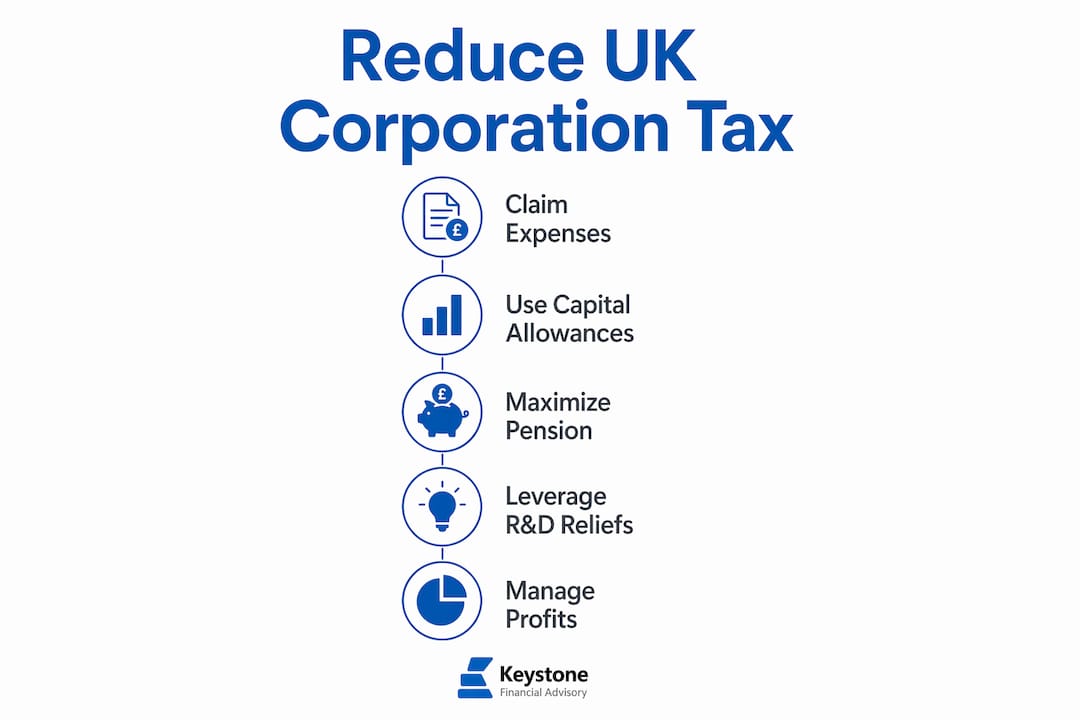
Reducing your UK corporation tax bill legally requires claiming all allowable expenses, maximising capital allowances, and planning pension contributions and profit timings around HMRC’s statutory reliefs.
Point | Details |
Claim all allowable expenses | Every cost that passes the “wholly and exclusively” test reduces taxable profits directly. |
Use AIA and full expensing | Claim 100% relief on qualifying assets in the year of purchase rather than spreading it over years. |
Contribute to employer pensions | Pension contributions are fully deductible and avoid National Insurance, making them highly efficient. |
Pre-notify HMRC for R&D claims | New R&D claimants must notify HMRC within six months of period end or lose the claim entirely. |
Manage profits within marginal relief | Timing costs to keep profits below £50,000 avoids the 26.5% effective rate in the marginal band. |
What I have learned from working with directors on corporation tax
Most of the tax savings I see come from meticulous record keeping and consistent use of reliefs that already exist, not from complex schemes. Directors who maintain clean expense records, contribute regularly to pension schemes, and time their capital purchases thoughtfully tend to pay significantly less tax than those who scramble at year end.
The R&D space concerns me most right now. The 2023 reforms created real compliance risk. I have seen well-intentioned claims rejected because the Additional Information Form was incomplete or the pre-notification deadline was missed by days. The relief is genuinely valuable, but it demands qualified oversight and thorough documentation. Cutting corners here is not worth the risk.
On remuneration, the salary-dividend balance is not a one-size-fits-all answer. It shifts every time NIC thresholds change, and the 2024 employer NIC increases changed the maths for many directors. Revisit this calculation annually, not once and forget it.
The businesses that consistently pay the least tax are not doing anything exotic. They are claiming what they are entitled to, keeping the records to prove it, and making decisions with the tax calendar in mind.
— Shoaib
How KeystoneFA helps UK companies reduce corporation tax
KeystoneFA works with founders, directors, and growing businesses to identify every legal opportunity to reduce their corporation tax liability. The team reviews expense claims against HMRC’s “wholly and exclusively” test, advises on capital allowance timing, and structures employer pension contributions for maximum efficiency.
[

For R&D claims, KeystoneFA provides qualified oversight and prepares the documentation HMRC now requires, including the Additional Information Form and pre-notification submissions. The team also advises on salary and dividend structuring as NIC rules evolve. If you want a clear picture of your current tax position and where savings are available, speak to KeystoneFA for a personalised review.
FAQ
What is the “wholly and exclusively” test?
The “wholly and exclusively” test is HMRC’s standard for deciding whether a business expense is allowable. Any cost with a personal benefit attached is likely to be disallowed or require apportionment.
Can dividends reduce my corporation tax bill?
Dividends do not reduce corporation tax. They are paid from post-tax profits, so only salary and other allowable expenses reduce the taxable profit figure.
What is the Annual Investment Allowance limit?
The Annual Investment Allowance currently covers up to £1 million of qualifying plant and machinery expenditure per year, giving 100% tax relief in the year of purchase.
Do R&D tax credit claims require pre-notification?
New R&D claimants must notify HMRC within six months of the accounting period end. Missing this deadline means the claim is automatically rejected, regardless of its merits.
How does marginal relief affect my corporation tax rate?
Marginal relief applies to profits between £50,000 and £250,000, creating an effective tax rate of 26.5% within that band. Reducing profits below £50,000 through allowable deductions drops the rate to 19%.
Recommended