Claiming mileage through a UK limited company


TL;DR:
Claiming mileage through a UK limited company at HMRC’s approved rates allows directors to reduce taxable profits without personal tax. Accurate logs and correct journey classification are essential to comply with HMRC rules and maximize tax efficiency. Using personal vehicles for qualifying business trips offers a straightforward, cost-effective way to claim mileage allowances legally.
Claiming mileage through a UK limited company is defined as reimbursing a director or employee for business travel in their personal vehicle at HMRC’s approved rates, reducing the company’s taxable profit with no personal tax liability on the payment. HM Revenue & Customs governs these payments through the Approved Mileage Allowance Payments (AMAP) scheme, which sets flat rates covering fuel, insurance, servicing, and depreciation. For the 2026/27 tax year, HMRC raised the approved rate for the first time in over 15 years, making this the most significant update to UK limited company mileage claims in recent memory. Getting this right saves money and keeps HMRC enquiries at bay.
What are the current HMRC approved mileage rates for 2026/27?
The AMAP rate for cars and vans is 55p per mile for the first 10,000 business miles in a tax year, dropping to 25p per mile for every mile beyond that threshold. This two-tier structure rewards higher-mileage directors with a generous rate up front, then reduces once the bulk of running costs are assumed to be covered. The 55p rate reflects the true cost of running a modern vehicle, including depreciation and insurance, not just fuel.

Vehicle type | First 10,000 miles | Over 10,000 miles |
Cars and vans | 55p per mile | 25p per mile |
Motorcycles | 24p per mile | 24p per mile |
Bicycles | 20p per mile | 20p per mile |
Directors can also claim an extra 5p per passenger per business mile when carrying fellow employees on a work-related journey. Both the director and the passenger must be travelling for business purposes. On a 100-mile round trip with two colleagues, that adds £10 to the claim at no tax cost.
Pro Tip: If your annual business mileage regularly exceeds 10,000 miles, consider splitting journeys across the tax year boundary where genuinely possible. Crossing into a new tax year resets the 10,000-mile counter and restores the higher 55p rate.
Which journeys qualify as allowable business mileage?
Ordinary commuting between home and a permanent workplace is not allowable business mileage under HMRC rules. This catches many directors off guard, particularly those who drive to a fixed office every day and assume the journey counts. The distinction matters because claiming ineligible commuting miles is a direct route to an HMRC enquiry.
A workplace becomes permanent when attendance is continuous and expected to last more than two years. Once a site crosses that threshold, travel to it becomes commuting, regardless of how the director labels it. A temporary site, by contrast, qualifies for mileage claims throughout the period of attendance.
Allowable journeys typically include:
Visiting a client or customer at their premises
Travelling to a supplier, contractor, or professional adviser
Moving between two or more business sites on the same day
Attending a temporary workplace for a project expected to last under two years
Travelling from a genuine home office to a client or meeting location
Pro Tip: If you work from home and your home qualifies as your principal place of business, every journey to a client or external meeting is allowable. Read more about home office expense claims to confirm your home office status before logging those miles.
How to correctly record and claim business mileage
Accurate mileage logs are the foundation of a compliant claim. HMRC requires each entry to include the date of travel, the start and end destination, the business purpose of the journey, and the total miles driven. A log missing any of these details can result in a rejected claim.
The AMAP scheme removes the need to keep fuel receipts. The flat mileage rate covers fuel, insurance, servicing, road tax, and depreciation, so directors claim the pence-per-mile figure and nothing more. This simplicity is one of the scheme’s biggest practical advantages over claiming actual vehicle costs.
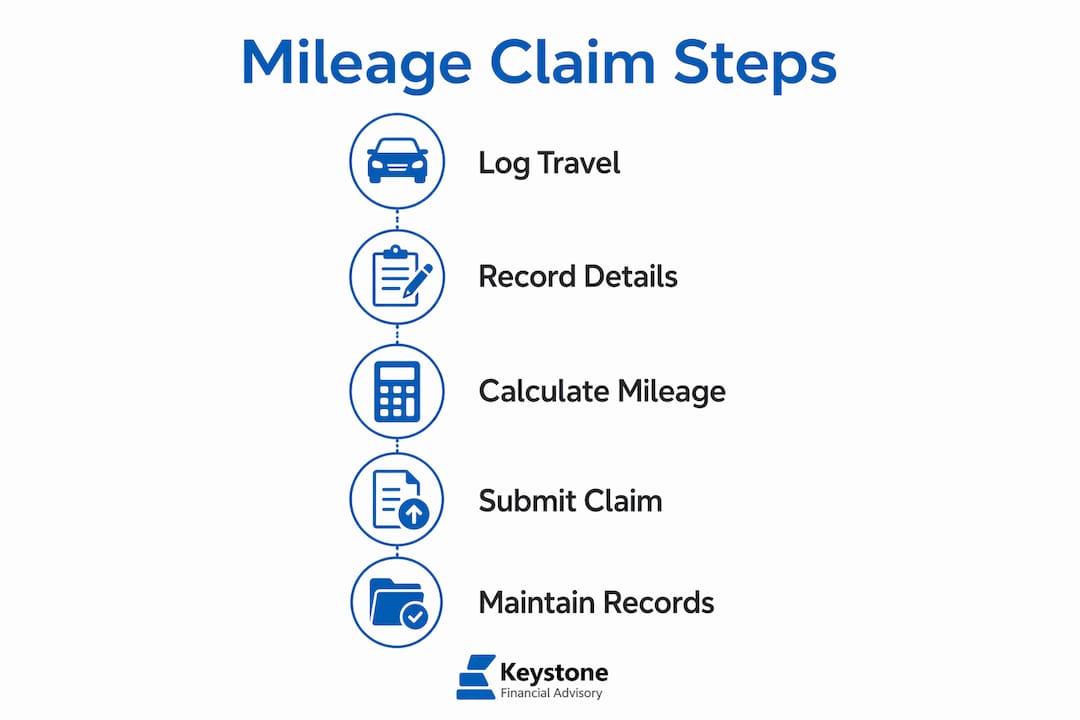
Follow these steps to process a mileage claim correctly:
Record each journey in a mileage log immediately after travel, noting date, destination, purpose, and miles.
Total the miles at the end of each month or quarter.
Apply the correct AMAP rate (55p for the first 10,000 miles, 25p thereafter).
Raise a mileage expense claim to the company and have it approved by a director or authorised signatory.
Reimburse the amount from the company bank account and record it as a business expense in the accounts.
Retain the mileage log for at least six years, in line with HMRC record-keeping requirements.
Failing to maintain detailed mileage logs can lead to rejected claims and formal HMRC enquiries, potentially creating unexpected tax liabilities. A simple spreadsheet or a dedicated mileage tracking app handles this with minimal effort. Many directors also find it useful to cross-reference logs against calendar entries or Google Maps history when preparing annual accounts.
Personal vehicle versus company-owned car: what changes?
AMAP rates apply exclusively to personal vehicles. Using a company-owned car precludes claiming AMAP rates; instead, the company deducts actual running costs and must account for benefit-in-kind (BIK) tax on any private use of the vehicle. BIK charges are calculated on the car’s list price and CO2 emissions, and they can be substantial for higher-emission vehicles.
For most directors driving a personal car for moderate business mileage, the AMAP route is more tax-efficient. The company gets a corporation tax deduction on the reimbursement, and the director pays no income tax or National Insurance on the payment, provided it does not exceed the approved rate. Explore the company car versus mileage comparison in detail to model which option suits your specific mileage and vehicle type.
Pro Tip: Electric vehicle drivers using a personal car can still claim AMAP rates. HMRC applies the same 55p per mile rate to electric and hybrid personal vehicles, making the scheme particularly attractive as running costs for EVs are lower than the flat rate implies.
A company car makes financial sense when the vehicle is used almost entirely for business, the BIK charge is low due to minimal emissions, and the company can reclaim VAT on fuel costs. For directors mixing personal and business use, the personal vehicle plus AMAP route almost always wins on simplicity and net tax cost.
Key takeaways
Claiming mileage through a UK limited company at HMRC’s AMAP rates is the most tax-efficient method for directors using personal vehicles, provided journeys are correctly classified and accurately recorded.
Point | Details |
Current AMAP rate | 55p per mile for the first 10,000 miles, then 25p per mile from april 2026. |
Commuting is excluded | Travel between home and a permanent workplace does not qualify as business mileage. |
No fuel receipts needed | The flat AMAP rate covers all vehicle running costs, removing the need for receipts. |
Company cars use different rules | AMAP rates do not apply to company-owned vehicles; BIK tax applies to private use instead. |
Records must be detailed | Each log entry needs the date, destination, purpose, and miles to withstand HMRC scrutiny. |
The mileage mistakes I see most often
The most common error I encounter is directors claiming their daily commute to a fixed office as business mileage. Understanding the temporary versus permanent workplace distinction is the single most important thing a director can do to protect their claims. I have seen otherwise clean tax returns unravel because of this one misclassification.
The second mistake is claiming AMAP rates on a company-owned car. The two systems are mutually exclusive, and mixing them is a red flag in any HMRC review. If the company owns the car, the company pays the running costs and accounts for BIK. If you own the car personally, you claim AMAP. There is no middle ground.
My practical advice is to log every journey the same day it happens. Memory fades, and a reconstructed log prepared months later rarely holds up. A brief note in your phone or a mileage app takes 30 seconds and is worth far more than the time spent defending a claim later. Directors who treat their mileage log with the same discipline as their invoices rarely face problems.
— Shoaib
How KeystoneFA supports your mileage and tax claims
Mileage claims sit within a broader picture of director expenses, corporation tax, and HMRC compliance. Getting one element wrong can affect the others.
[
KeystoneFA works with limited company directors across the UK to make sure every allowable business expense is claimed correctly and every record is HMRC-ready. From reviewing your mileage logs to advising on the company car versus personal vehicle decision, the team brings practical experience from both UK and international tax environments. Book a tax consultation with KeystoneFA to get clear, personalised guidance on your mileage claims and wider tax position. You can book online in minutes and speak to an adviser who understands the realities of running a limited company.
FAQ
What is the HMRC mileage rate for limited companies in 2026/27?
The HMRC approved rate for cars and vans is 55p per mile for the first 10,000 business miles and 25p per mile thereafter. This rate applies when directors use their personal vehicle for business travel.
Can I claim mileage for travelling to my regular office?
No. Travel between your home and a permanent workplace is classified as ordinary commuting and is excluded from AMAP claims. Only journeys to temporary workplaces or client and supplier locations qualify.
Do I need to keep fuel receipts to claim mileage?
No. The AMAP flat rate covers all vehicle running costs, including fuel, so no fuel receipts are required. You must, however, maintain a detailed mileage log for each journey claimed.
Can I claim AMAP rates if my company owns the car?
No. AMAP rates apply only to personal vehicles. If your company owns the car, it deducts actual running costs and must account for benefit-in-kind tax on any private use of the vehicle.
What records does HMRC require for mileage claims?
Each mileage log entry must include the date of travel, start and end destination, business purpose, and total miles driven. HMRC expects these records to be retained for at least six years.
Recommended