UK audit readiness check services: your 2026 guide

TL;DR:
UK audit readiness check services identify gaps in financial records and controls before a statutory audit begins. Starting preparations 1-3 months before year-end helps reduce delays, costs, and disruption during the audit process. Consistent, year-round control documentation and communication with auditors lead to smoother, faster, and more cost-effective audits.
UK audit readiness check services are pre-engagement reviews that identify gaps in financial records, internal controls, and documentation before a statutory audit begins. Think of them as a dress rehearsal: you find the problems before the auditors do. For UK business owners, the difference between a prepared audit file and a reactive scramble can mean weeks of disruption, unexpected fees, and regulatory scrutiny from HMRC or Companies House. The industry term for this discipline is “audit readiness,” and it sits at the intersection of UK financial audit preparation, internal controls management, and compliance with standards such as ISA (UK) and the Companies Act 2006.
What are the key components of UK audit readiness check services?
Effective audit readiness begins with a Prepared by Client (PBC) list. This is the master document your auditors use to request evidence, and it typically includes your trial balance, bank statements, fixed asset register, aged debtors and creditors, and board minutes. Ready PBC files can reduce engagement durations from two months to two weeks in some scenarios. That compression translates directly into lower audit fees and less disruption to your finance team.

Internal controls sit at the heart of any audit assessment. Auditors prioritise evidence of effective controls because segregation of duties and payment approvals are the mechanisms that safeguard your assets. If your approval process for supplier payments is undocumented or inconsistently applied, auditors will flag it. Documenting who authorises what, and keeping that documentation current, removes one of the most common causes of audit delay.
Reconciliation procedures are equally critical. Key accounts including bank, payroll control, VAT, and intercompany balances need to reconcile cleanly before fieldwork starts. Beyond the numbers, auditors also review governance evidence: contracts, tax filings, and board minutes that fall within the audit scope.
Trial balance and management accounts signed off and reconciled to source ledgers
Bank statements and reconciliations for all accounts, including foreign currency
Fixed asset register with additions, disposals, and depreciation schedules
Board minutes covering material decisions, dividends, and related-party transactions
Tax filings including corporation tax computations and VAT returns
Contracts for significant leases, loans, and customer agreements
Internal control documentation covering approval limits, segregation of duties, and IT access
Pro Tip: Map your PBC list to your accounting software’s report library at the start of the financial year. When audit time arrives, you generate rather than reconstruct.
When and how should UK businesses conduct readiness checks?
The right time to start is not january. Readiness reviews conducted 1–3 months before financial year-end give you enough runway to fix control weaknesses and gather missing documentation without a crisis. Starting in the final two weeks is the single most common cause of audit bottlenecks.
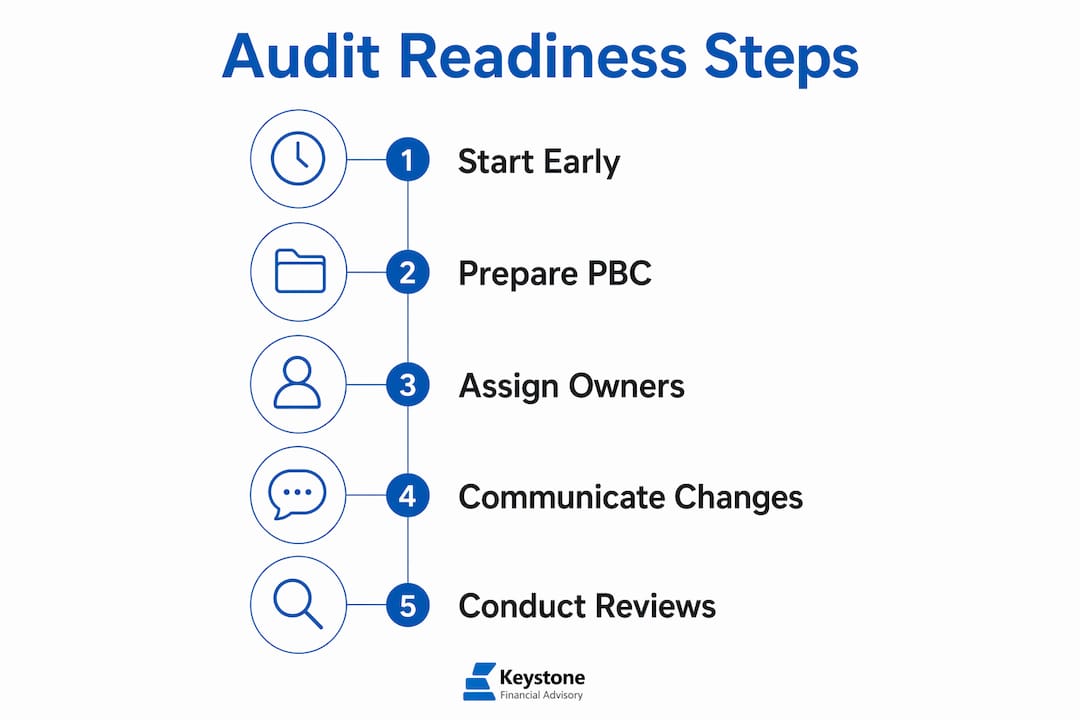
The most effective approach treats audit readiness as a monthly discipline rather than a year-end event. Monthly bank reconciliations, aged debt reviews, and timely posting of accruals are the building blocks of a clean audit file. Each month you close properly is one less month your auditors need to reconstruct.
A practical readiness timeline looks like this:
Month 1 of the financial year: Agree the PBC list with your auditors and assign ownership of each item internally.
Monthly close: Complete bank reconciliations, post accruals and prepayments, and review aged balances.
Three months before year-end: Conduct a full internal review of control documentation and flag any gaps to your finance lead.
Six weeks before year-end: Disclose any major operational changes, acquisitions, or accounting policy updates to your auditors.
Two weeks before fieldwork: Deliver the completed PBC file and confirm all reconciliations are signed off.
Communicating major events such as acquisitions, new financing, or policy changes to auditors before fieldwork begins avoids surprises and facilitates clean audit opinions. Late disclosure forces auditors to redesign their testing, which costs everyone time.
Pro Tip: Assign a named owner to each PBC item in a shared tracker. Ownership without a name attached is no ownership at all.
What common pitfalls do UK businesses face in audit readiness?
The most damaging mistake is treating audit preparation as a year-end task. Finance teams that treat audits as year-end events often encounter costly bottlenecks that delay sign-off and inflate professional fees. The fix is simple in principle: build your audit file progressively throughout the year.
Poor control documentation is the second most frequent problem. Weak or undocumented controls cause audit delays and challenges because auditors cannot rely on controls they cannot verify. A payment authorisation policy that lives in someone’s head rather than a written procedure is invisible to an auditor.
Waiting until year-end to gather documentation creates bottlenecks and inflates audit fees.
Undocumented controls force auditors to expand substantive testing, adding time and cost.
Failure to disclose changes such as new accounting policies or restructuring events delays the risk assessment process.
Overlooking governance records including board minutes and compliance certificates leaves auditors without evidence of oversight.
Inconsistent reconciliations across periods signal control weaknesses and invite additional scrutiny.
“Audit readiness is as much about trust-building with auditors through clear and timely documentation as it is about compliance. Businesses that communicate openly and prepare thoroughly consistently achieve faster, cleaner audit outcomes.”
The governance gap is underappreciated. Many business owners focus entirely on financial evidence and overlook non-financial records. Board minutes that document material decisions, risk registers, and compliance certificates are all within scope for a thorough audit assessment.
How can UK audit readiness check services support small and medium-sized businesses?
Smaller businesses face a specific challenge: lean finance teams carry the same audit obligations as larger organisations but with fewer resources. Structured audit readiness support relieves that pressure by providing a clear framework, external review, and expert guidance on what auditors actually need.
Companies exceeding turnover above £15m, assets above £7.5m, or 50 employees must have a statutory audit under the Companies Act 2006. Smaller companies often choose audits voluntarily due to investor or lender requirements. Knowing which threshold applies to your business shapes the scope of your readiness work.
Proper business records management is the foundation that audit readiness services build on. Without organised records, even the best readiness framework cannot compensate.
Benefit | What it means for your business |
Structured PBC support | Reduces time spent gathering documents during fieldwork |
Control gap identification | Flags weaknesses before auditors find them |
Compliance guidance | Clarifies Companies Act thresholds and exemption rules |
Auditor coordination | Aligns expectations early to reduce fieldwork disruption |
Risk management insights | Surfaces control improvements with operational value |
Audit committees or external reviewers assessing controls quarterly contribute to sustained audit readiness and governance compliance. For SMEs without a formal audit committee, an external adviser fulfils that function cost-effectively.
KeystoneFA works with founders and growing businesses to build this structure from the ground up, integrating readiness checks into monthly accounting routines rather than treating them as a separate annual exercise. Their team’s experience across UK and Middle East firms means they understand both the regulatory expectations and the practical constraints of smaller finance teams.
Key takeaways
Audit readiness is a year-round discipline, not a year-end task, and businesses that embed it into monthly routines consistently achieve faster, cleaner, and less costly audits.
Point | Details |
Start early | Begin readiness reviews 1–3 months before year-end to fix gaps before fieldwork. |
Build a PBC list | Assign ownership of every document request at the start of the financial year. |
Document your controls | Written procedures for approvals and segregation of duties are auditor evidence. |
Communicate changes | Disclose acquisitions, policy changes, and major events to auditors before fieldwork. |
Embed monthly habits | Bank reconciliations, aged debt reviews, and accruals posted on time build a clean file. |
Audit readiness as a year-round discipline: my honest view
I have worked with finance teams across a wide range of UK businesses, and the pattern is consistent. The businesses that struggle most with audits are not the ones with the most complex accounts. They are the ones that treat the audit as something that happens to them rather than something they prepare for.
The real value of audit readiness consulting services is not the checklist. It is the shift in mindset. When a finance team starts closing each month as if an auditor might review it tomorrow, the quality of their records improves permanently. That improvement shows up in faster audit sign-off, yes, but it also shows up in better management information and sharper financial decision-making.
Early communication with external auditors is the most underused tool available to UK business owners. Auditors are not adversaries. When you tell them about a significant contract, a change in accounting policy, or a restructuring event before fieldwork begins, you give them the context to plan efficiently. That context reduces the number of queries you receive during the audit. Fewer queries means less disruption to your team.
The statutory accounts preparation process and audit readiness are two sides of the same coin. Businesses that treat them as connected disciplines rather than separate tasks consistently outperform those that do not.
My advice: pick one month this year and close it as if your auditors are arriving the following week. The gaps you find will tell you exactly where to focus your readiness effort.
— Shoaib
How KeystoneFA supports your audit readiness
Audit preparation does not have to fall entirely on your internal team. KeystoneFA provides audit readiness and compliance support tailored for UK founders, startups, and growing businesses, covering everything from PBC list management and control documentation to HMRC and Companies House compliance.
[

Their specialists work alongside your finance team to identify gaps before auditors do, coordinate with your external auditors to align expectations early, and deliver fixed-fee proposals so you know the cost upfront. Whether you face a statutory audit for the first time or want to reduce the disruption of an annual process, KeystoneFA provides the structured support to make it manageable. Contact them to arrange a consultation and find out what a tailored readiness review looks like for your business.
FAQ
What are UK audit readiness check services?
UK audit readiness check services are pre-engagement reviews that assess your financial records, internal controls, and documentation before a statutory audit begins. Their purpose is to identify gaps early so they can be resolved before auditors arrive.
How far in advance should I start audit preparation?
Readiness reviews should begin 1–3 months before your financial year-end to allow sufficient time to address control weaknesses and gather missing documentation without disrupting normal operations.
Does my business need a statutory audit?
Companies exceeding turnover above £15m, assets above £7.5m, or 50 employees require a statutory audit under the Companies Act 2006. Smaller businesses may still need one due to investor or lender requirements.
What documents do auditors typically request?
Auditors request a PBC list that typically includes the trial balance, bank reconciliations, fixed asset register, board minutes, tax filings, and key contracts. Having these ready before fieldwork begins reduces engagement time significantly.
How do internal controls affect audit outcomes?
Weak or undocumented controls force auditors to expand their substantive testing, which adds time and cost. Well-documented controls give auditors confidence in your financial information and reduce the scope of additional testing.
Recommended