Accounting for pre-revenue startups: a founder's guide

TL;DR:
Starting accounting early helps pre-revenue startups build accurate financial records and signals operational discipline to investors.
Adopting accrual basis accounting and maintaining clean books from the start simplifies future fundraising and compliance efforts.
Accounting for pre-revenue startups is the practice of recording financial transactions, tracking expenses, and producing compliant reports before a single pound of income arrives. Most founders treat this as an afterthought, but that decision costs them dearly at the fundraising table. Getting your books right from day one gives you clarity on cash, credibility with investors, and a clean record for HMRC. Tools like QuickBooks Online, Xero, and even a well-structured spreadsheet can form the backbone of a sound early-stage system.
What accounting methods work best for pre-revenue startups?
Two methods define startup accounting basics: cash basis and accrual basis. Each suits a different stage and a different level of complexity.

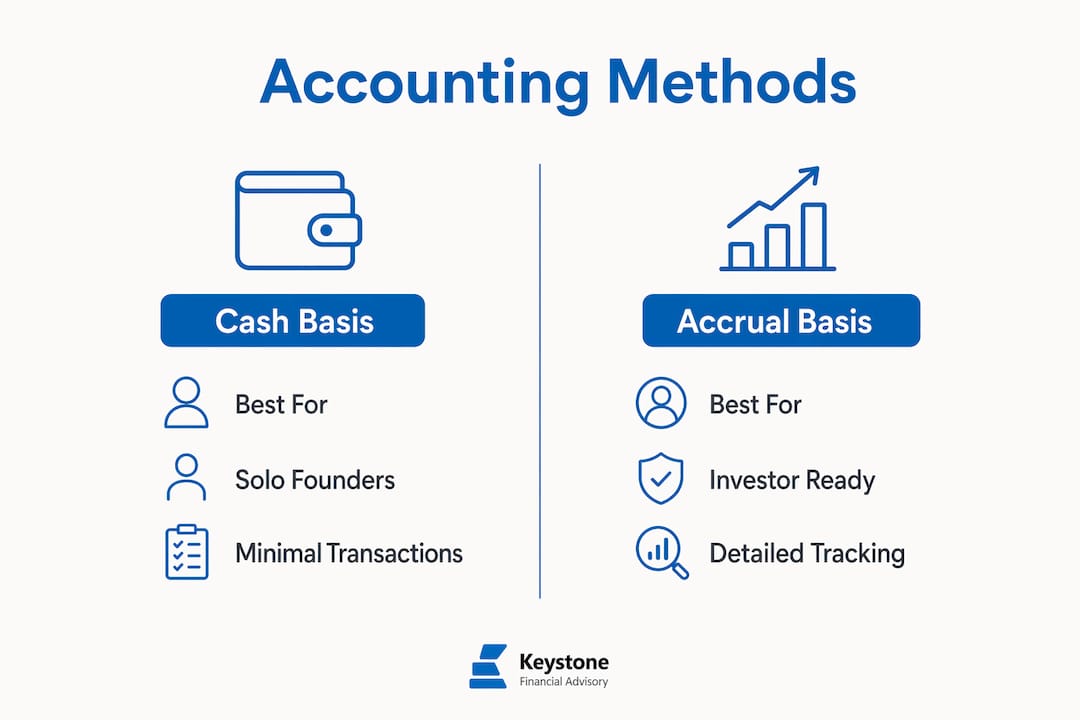
Cash basis accounting records income when cash is received and expenses when cash leaves the account. It is straightforward and well-suited to a founder with minimal transactions and no investors yet. In the UK, businesses with turnover under £150,000 can use cash accounting under HMRC guidelines, making it a legitimate starting point for very early-stage companies.
Accrual basis accounting records revenue when it is earned and expenses when they are incurred, regardless of when cash moves. This method is required for GAAP-compliant financials, which investors expect before any serious funding round. Switching from cash to accrual mid-cycle is messy and expensive, so founders planning to raise capital within 12–18 months should adopt accrual from the start.
Method | Best for | Investor-ready? |
Cash basis | Solo founders, minimal transactions | No |
Accrual basis | Startups planning to fundraise | Yes |
Pro Tip: If you are unsure which method to use, default to accrual. Restating historical accounts from cash to accrual during due diligence is one of the most avoidable costs in a startup’s life.
Which tools and bookkeeping practices should founders use?
The right tool depends on your complexity, not your ambition. A founder with three expense categories and no staff does not need enterprise software on day one.
Spreadsheets (Google Sheets, Microsoft Excel): Suitable for the very earliest stage. Free, flexible, and adequate when transactions are few.
Xero: Cloud-based, clean interface, and widely used by UK accountants. Strong bank reconciliation and HMRC-compatible VAT filing.
QuickBooks Online: Broader feature set, including revenue recognition tools. QuickBooks Online Advanced includes features for SaaS subscription models, making it useful if you plan a recurring-revenue product.
Beyond choosing software, bookkeeping discipline matters more than the tool itself. Categorise every expense from the first transaction. Keep receipts digitally using apps like Dext or Hubdoc. Reconcile your bank account weekly, not monthly. Organising bookkeeping early reduces the risk of costly corrective accounting and supports better financial decisions when it matters most.
Tool | Best for | Key feature |
Google Sheets | Pre-seed, solo founder | Free, fully customisable |
Xero | UK-based startups | HMRC VAT filing, bank feeds |
QuickBooks Online | SaaS or subscription models | Revenue recognition, reporting |
Pro Tip: Open a dedicated business bank account on the day you incorporate. Mixing personal and business transactions is the single most common bookkeeping error founders make, and it creates hours of corrective work later.
How to manage cash flow and expense tracking before revenue starts
Poor cash flow management contributes to 82% of startup failures, with 29% running out of money entirely before gaining traction. That figure is not a warning. It is a mandate to treat cash flow as your most important financial metric from day one.
Burn rate is the amount of cash your business spends each month. Runway is how many months of cash you have left at the current burn rate. Both numbers are simple to calculate and critical to know. A founder who cannot state their runway in under ten seconds does not have a grip on their finances.
Practical cash flow management for pre-revenue founders requires discipline across several areas:
Separate every owner expense from business costs. Pay yourself a defined amount and record it correctly.
Categorise operating expenses into fixed costs (rent, software subscriptions) and variable costs (contractors, travel).
Build a monthly cash flow forecast in a spreadsheet. Update it every week against actual bank movements.
Track your burn rate monthly and recalculate runway after every significant spend.
Identify your largest cost categories and review them quarterly for reduction opportunities.
Forecasting is not guesswork. It is a structured estimate based on signed contracts, committed spend, and known payment dates. Even without revenue, you can model when cash will run out and plan accordingly.
What key financial metrics should pre-revenue founders track?
Key metrics for pre-revenue startups include burn rate, runway, gross margin, customer acquisition cost, and lifetime value. Tracking these before revenue arrives shapes your pricing strategy and your investor narrative.
Gross margin deserves attention even at the pre-revenue stage. If you know your expected cost of goods sold and your target price, you can model whether your business is structurally profitable at scale. A SaaS product with 80% gross margin tells a very different story to a hardware product at 30%.
Cap table management is another metric that founders routinely neglect until it becomes urgent. A clean cap table documenting equity ownership is vital for investor communication and fundraising. Record every share issuance, option grant, and convertible note from the first day. Tools like Carta or SeedLegals make this straightforward for UK founders.
Preparing GAAP-compliant financial statements, even in draft form, signals to investors that your business is run with rigour. An income statement, balance sheet, and cash flow statement form the core trio. You do not need revenue to produce them.
How do accounting practices prepare startups for fundraising and compliance?
Clean books are the single most persuasive non-financial signal you can send to an investor. Disorganised records create doubt about your operational competence, regardless of how strong your product is.
Fundraising readiness requires four specific accounting steps:
Adopt accrual basis accounting before approaching investors.
Produce monthly management accounts, even if they show only costs.
Maintain a current cap table with all equity and option grants recorded.
File all statutory returns with Companies House and HMRC on time.
Tax compliance requires up-to-date filings and a clear record of all obligations, even before revenue generation. HMRC expects accurate records from the date of incorporation, not from the date you first invoice a customer. Missing early filings creates penalties that compound and distract you at the worst possible time.
For SaaS founders specifically, revenue recognition adds another layer. Booking cash as deferred revenue until services are delivered is required under IFRS 15. Getting this right from the first subscription sale avoids a painful restatement later.
“The cost of fixing messy accounts during a fundraising round is always higher than the cost of keeping them clean from the start.”
For a detailed breakdown of what statutory accounts require, the statutory accounts preparation guide from KeystoneFA covers the full process for UK businesses.
Key takeaways
Accounting for pre-revenue startups requires accrual-basis records, disciplined cash flow tracking, and GAAP-compliant statements before any fundraising conversation begins.
Point | Details |
Choose the right method | Adopt accrual basis accounting if you plan to raise capital within 12–18 months. |
Use appropriate tools | Xero or QuickBooks Online suit most UK startups; spreadsheets work only at the very earliest stage. |
Track burn rate weekly | Know your runway at all times. Poor cash flow causes 82% of startup failures. |
Maintain a clean cap table | Record every share and option grant from day one to support investor due diligence. |
File early and accurately | HMRC and Companies House expect records from incorporation, not from first revenue. |
Why I tell every pre-revenue founder to treat accounting as a product
Most founders I speak with view accounting as a compliance chore. That framing is the problem. Your financial records are a product you are building for your future investors, your future self, and HMRC. The quality of that product reflects your operational standards.
The most common mistake I see is waiting until the first funding conversation to get the books in order. By that point, a founder is paying an accountant to reconstruct six months of transactions under time pressure, often at two or three times the normal rate. The irony is that the cost of prevention is a fraction of the cost of correction.
Start with the simplest system that keeps your records clean and complete. Upgrade the system when complexity demands it, not before. And never mix personal and business finances. That single discipline alone eliminates the majority of bookkeeping problems I encounter with early-stage clients.
Accounting is not just an obligation. It is the clearest signal of how seriously you take your own business.
— Shoaib
How KeystoneFA supports founders before revenue arrives
Pre-revenue accounting is where KeystoneFA specialises. The team works with founders from incorporation, setting up the right accounting method, bookkeeping systems, and compliance processes before the first invoice is ever raised.
KeystoneFA’s startup accounting services cover everything from day-to-day bookkeeping to HMRC compliance and tax planning. Founders who need specific guidance on tax obligations can access dedicated tax consultation from advisers with direct experience in UK startup finance. Booking a consultation takes minutes via the online booking page, and the earlier you engage, the less you pay to fix problems later.
FAQ
What does accounting for pre-revenue startups involve?
Accounting for pre-revenue startups means recording all financial transactions, tracking expenses, and producing compliant financial statements before generating income. It includes choosing an accounting method, maintaining clean books, and filing statutory returns with HMRC and Companies House.
Should a pre-revenue startup use cash or accrual accounting?
Startups planning to raise investment should use accrual basis accounting from the outset, as investors expect GAAP-compliant financials. Founders with no fundraising plans and turnover under £150,000 can use cash basis accounting under HMRC rules.
What financial metrics matter before a startup earns revenue?
Burn rate, runway, and gross margin are the three most critical metrics for pre-revenue founders. Tracking these figures monthly gives you the data to make sound spending decisions and present a credible picture to investors.
How does early bookkeeping help with fundraising?
Clean, well-organised accounts signal operational competence to investors and reduce the time and cost of due diligence. Disorganised records at the fundraising stage create doubt and can delay or derail a round entirely.
When should a pre-revenue startup hire an accountant?
Engaging an accountant at incorporation, rather than at the first funding round, is the most cost-effective approach. Early professional support prevents the expensive corrective accounting that founders often face when they wait too long.
Recommended