Can my UK limited company pay my personal expenses?

TL;DR:
A UK limited company can pay personal expenses only through strict, documented routes like reimbursements, director’s loans, or benefits in kind. Improper use of company funds risks tax penalties, legal action, and charges such as the Section 455 and benefit in kind taxes. Proper planning, record-keeping, and professional advice help ensure compliance and tax efficiency.
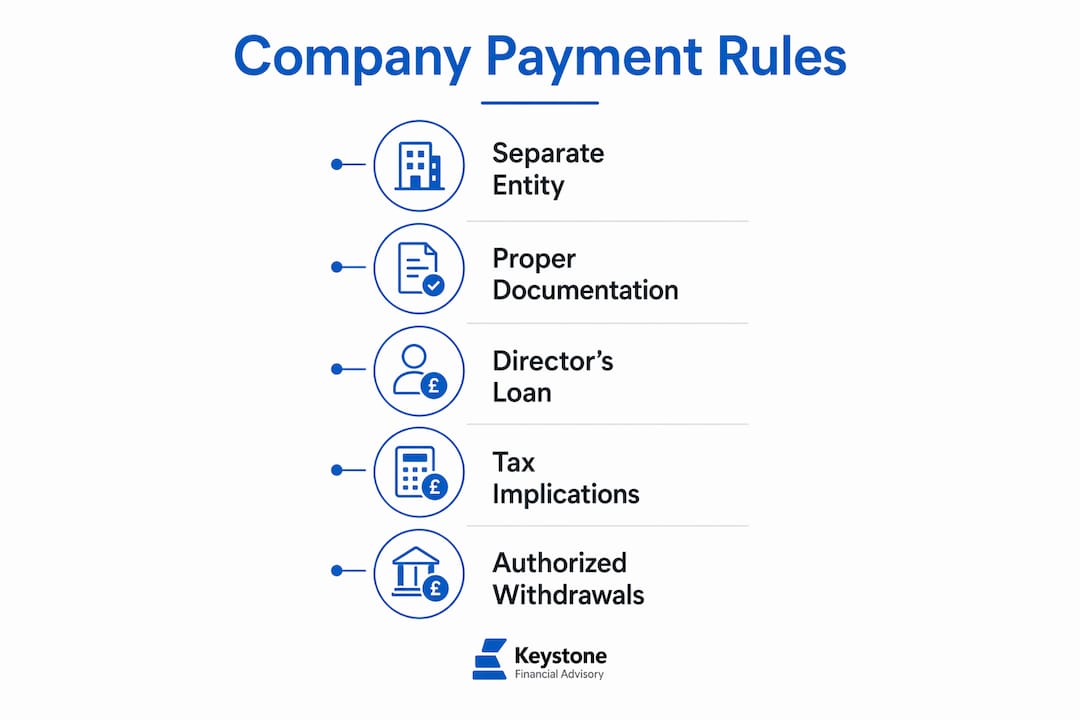
A UK limited company is a separate legal entity from its directors and shareholders. That distinction defines everything about how company funds may be used for personal costs. The short answer to whether your company can pay your personal expenses is: only under specific, controlled conditions that satisfy HMRC rules. Get it wrong, and you face tax charges, penalties, and in serious cases, legal action. This guide covers the rules on company paying personal expenses, the tax implications, and the compliant methods available to you as a director.

Can my UK limited company pay my personal expenses?
The governing principle is HMRC’s “wholly and exclusively” rule, set out in Section 54 of the Corporation Tax Act 2009. An expense is only allowable if it is incurred wholly and exclusively for business purposes, with proper records to prove it. Anything with a personal element risks being disallowed or reclassified as a benefit in kind (BIK), which triggers additional tax charges.
Your company can legitimately cover personal costs in three specific ways:
Reimbursement of business expenses. If you pay a business cost from your own pocket, the company can reimburse you tax-free, provided you keep receipts and document the business purpose clearly.
Director’s Loan Account (DLA). The company can pay a personal cost and record it as a loan to you via the DLA. This must be repaid to avoid tax charges.
Benefits in kind. The company can provide certain personal benefits, such as private medical insurance, but these are taxable on you personally and subject to Class 1A National Insurance contributions from the company.
Pro Tip: Keep a separate folder, physical or digital, for every receipt linked to a business expense claim. HMRC expects clear evidence of business purpose, not just a bank statement.
The Director’s Loan Account records all financial transactions between you and the company that fall outside salary, dividends, and expense reimbursements. Managing it carefully is not optional. It is the central record HMRC examines when it questions whether company funds have been used correctly.
What are the tax and legal implications?
The tax consequences of getting this wrong are significant. Two charges apply most frequently to directors who use company funds for personal costs without proper controls.
First, the Section 455 charge. If your DLA is overdrawn nine months after the company’s year-end, the company pays a Corporation Tax charge of 35.75% on the outstanding balance. That charge is repayable when you repay the loan, but it ties up cash and creates an administrative burden. The “bed and breakfasting” rule also applies: if you repay a loan and re-borrow within 30 days, HMRC treats it as a continuous loan, so timing repayments to dodge the charge does not work.
Second, the benefit in kind threshold. If your overdrawn loan exceeds £10,000 interest-free, you face a personal BIK tax charge and the company owes Class 1A National Insurance contributions on the benefit. Loans below £10,000 are generally not BIK-taxable, but the moment you cross that threshold, both personal and company tax bills increase.
Risk | Trigger | Consequence |
Section 455 charge | DLA overdrawn 9+ months after year-end | 35.75% Corporation Tax on outstanding balance |
Benefit in kind | Interest-free loan exceeds £10,000 | Personal income tax plus Class 1A NIC for the company |
Disallowed expense | Personal element in claimed cost | Expense added back; potential BIK reclassification |
Legal breach | Unauthorised withdrawal of company funds | Repayment order, director disqualification, or fraud charges |
The legal risks go beyond tax. Misuse of company funds for personal gain without proper authority can constitute a breach of director duties or fraud. HMRC may treat unauthorised withdrawals as loans, unlawful distributions, or a breach of fiduciary duty. The consequences include repayment orders and, in serious cases, director disqualification.
How does HMRC treat dual-purpose expenses?
Dual-purpose expenses are costs that serve both a business and a personal function. HMRC applies the “wholly and exclusively” test strictly. Expenses with significant personal use are usually disallowed entirely, not apportioned. That is a harder line than many directors expect.
Common examples of costs that fall into this grey area:
Home heating and electricity. These usually have unavoidable personal elements and are generally not allowable unless you calculate a proportionate home office claim using HMRC-approved methods.
Mobile phone contracts. A single business phone contract in the company’s name is allowable. A personal contract reimbursed by the company is not, unless the business use is wholly exclusive.
Clothing. A suit worn to client meetings is not allowable because it doubles as everyday wear. Branded workwear or protective clothing is allowable.
Meals. Subsistence costs during business travel are allowable. Lunch at your desk is not. See the rules on meals and subsistence for the full picture.
HMRC uses a narrow definition of business expenses for directors, specifically because directors hold employee status within their own company. That increases BIK risk on any benefit that has a personal dimension.
Pro Tip: For home office claims, calculate the proportion of your home used exclusively for work and apply that to relevant costs. A dedicated room used only for business is far easier to defend than a kitchen table.
Claiming home office expenses through your limited company requires careful apportionment and clear records. The claim must be defensible if HMRC asks questions.
What are the proper methods for withdrawing money for personal use?
Directors have four compliant routes for accessing company funds personally. Each carries different tax treatment.
Salary via PAYE. The company pays you a salary, deducts Income Tax and National Insurance contributions, and reports through PAYE. This is straightforward but not always the most tax-efficient route for owner-directors.
Dividends. As a shareholder, you can receive dividends from post-tax profits. Dividends are taxed at lower rates than salary, but they require sufficient retained profits and must be properly declared with board minutes and dividend vouchers.
Director’s Loan Account repayments. If you have previously lent money to the company, you can draw it back tax-free. This is distinct from borrowing from the company, which creates the DLA risks described above.
Reimbursed business expenses. You pay a genuine business cost personally, submit a claim with receipts, and the company reimburses you. No tax arises if the expense is wholly and exclusively for business.
Paying personal bills directly from the company account sits outside all four routes. It is not a salary, not a dividend, and not a reimbursement. HMRC will treat it as either a director’s loan or an unlawful distribution, both of which carry tax consequences. For a full breakdown of tax-efficient withdrawals, the combination of a modest salary and dividends remains the most widely used approach for owner-directors.
Key takeaways
A UK limited company can only pay personal expenses through controlled, documented routes. Any payment outside salary, dividends, reimbursed business costs, or a properly managed DLA risks triggering Corporation Tax charges, benefit in kind liabilities, or legal action.
Point | Details |
Wholly and exclusively rule | Every expense must be incurred purely for business purposes to be allowable under S54 CTA 2009. |
Section 455 charge | An overdrawn DLA outstanding 9+ months after year-end triggers a 35.75% Corporation Tax charge. |
BIK threshold | Interest-free director loans above £10,000 create a personal tax charge and Class 1A NIC liability. |
Dual-purpose expenses | HMRC disallows costs with significant personal use entirely, rather than allowing partial claims. |
Compliant withdrawal routes | Salary, dividends, DLA repayments, and reimbursed expenses are the only compliant methods. |
Where most directors go wrong
The most common mistake I see is treating the company account as a personal current account. A director draws cash for a personal purchase, intends to sort it out later, and then forgets. Months pass, the DLA grows, and by the time the accountant flags it, the Section 455 charge is already due.
The second mistake is assuming that because an expense has some business connection, it is automatically allowable. HMRC does not work that way. The test is strict, and the burden of proof sits with you. I have seen legitimate-looking claims disallowed because the director could not produce a receipt or explain the business purpose clearly.
My advice is to treat the company’s money as belonging to the company, because legally it does. Set up a proper expenses policy, even if you are a sole director. Record every transaction the day it happens. If you need to borrow from the company, document it as a loan immediately and plan your repayment before the nine-month deadline arrives.
The interplay of director loans, dividends, salaries, and benefits is genuinely complex. Careless use of company funds for personal costs can trigger multiple overlapping tax charges simultaneously. Professional accounting support is not a luxury for a growing business. It is the most cost-effective way to avoid expensive mistakes.
— Shoaib
How KeystoneFA helps you stay compliant
Managing the line between personal and company finances is one of the most common pressure points for UK founders and directors. KeystoneFA works with business owners to get this right from the start.
[
KeystoneFA’s team reviews your director’s loan account, expenses policy, and withdrawal structure to identify risks before HMRC does. Whether you need help with allowable expense claims, dividend planning, or PAYE compliance, the team provides clear, practical guidance tailored to your company’s position. Avoiding a Section 455 charge or a BIK liability is far cheaper than paying one. Get in touch with KeystoneFA to put the right structures in place.
FAQ
Can my limited company pay my personal phone bill?
Only if the contract is in the company’s name and the phone is used exclusively for business. A personal contract reimbursed by the company is not allowable and may be treated as a benefit in kind.
What happens if I pay personal expenses from the company account?
HMRC will treat the payment as either a director’s loan or an unlawful distribution. An overdrawn loan outstanding more than nine months after year-end triggers a Section 455 charge of 35.75%.
Is there a limit on how much I can borrow from my company tax-free?
Interest-free director loans up to £10,000 are generally not subject to benefit in kind tax. Loans above that threshold create a personal tax charge and Class 1A National Insurance contributions for the company.
Can my company reimburse me for working from home?
Yes, but only for the proportion of costs that relate exclusively to business use. Costs like heating and electricity require careful apportionment and clear records to withstand HMRC scrutiny.
What is the most tax-efficient way to take money from my limited company?
For most owner-directors, a combination of a modest salary below the National Insurance threshold and dividends from post-tax profits is the most tax-efficient approach. A qualified accountant should review your specific position annually.
Recommended