Buy-to-let: personal ownership vs limited company in the UK

TL;DR:
Choosing a buy-to-let ownership structure depends on your tax bracket, portfolio size, and investment goals. Limited companies offer full mortgage interest deduction and tax advantages for higher-rate investors but entail higher borrowing and compliance costs. Personal ownership suits smaller portfolios with simpler management, whereas companies support long-term growth and flexible estate planning.
The buy-to-let ownership structure you choose is one of the most consequential financial decisions you will make as a UK property investor. Holding property personally and holding it through a UK limited company produce fundamentally different tax outcomes, borrowing costs, and administrative obligations. Over 75% of new buy-to-let purchases in Q2 2026 were made through limited companies, driven largely by Section 24 mortgage interest restrictions that hit personal landlords hard. The right structure depends on your tax bracket, portfolio size, and long-term investment goals.
Should buy-to-let properties be held personally or through a UK limited company?
The answer depends primarily on your income tax position. Basic-rate taxpayers with smaller portfolios typically find personal ownership more cost-effective. Higher-rate taxpayers, or those planning to grow a portfolio and reinvest profits, generally benefit more from a limited company structure.

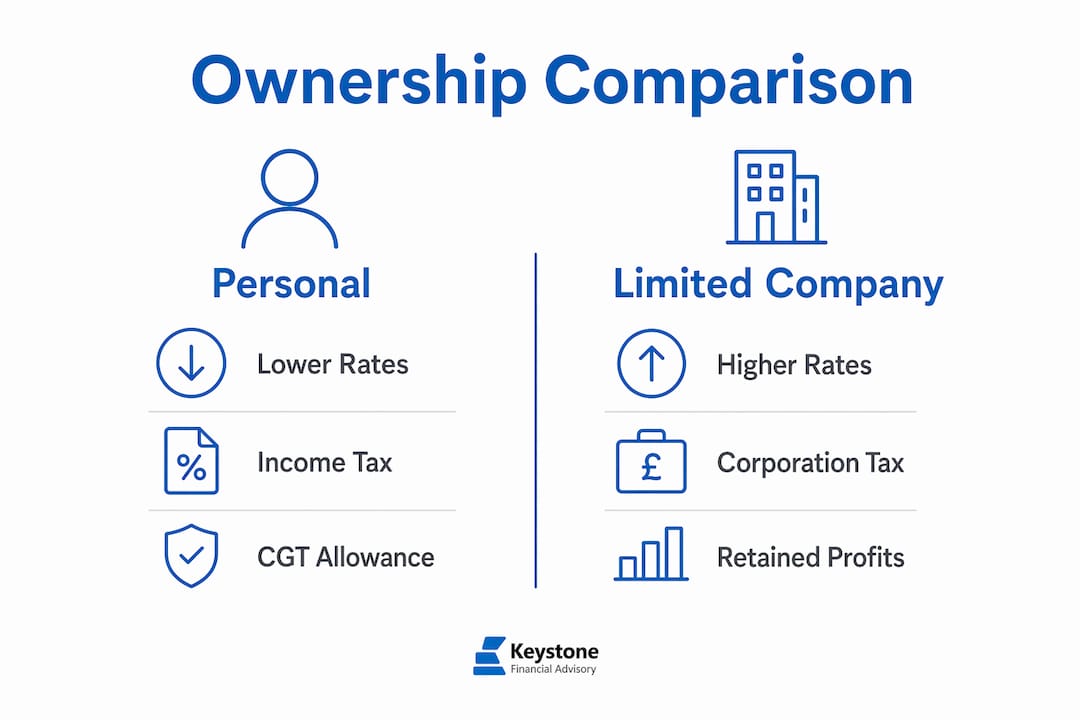
Personal ownership means rental income is taxed as part of your total income under HMRC’s standard income tax bands. A higher-rate taxpayer pays 40% on rental profits. A limited company pays corporation tax at rates between 19% and 25%, depending on profits. That gap matters enormously when you are earning significant rental income.
Section 24, introduced by HMRC, is the single biggest driver of the shift toward company ownership. Under Section 24, personal landlords can no longer deduct mortgage interest from rental income. Instead, they receive only a 20% tax credit. Higher-rate taxpayers lose 20–25p per pound on every pound of mortgage interest paid. A limited company, by contrast, deducts mortgage interest as a business expense in full, which directly reduces taxable profit.
Capital Gains Tax also differs. Personal landlords benefit from an annual CGT allowance when selling, though that allowance has been reduced significantly in recent years. Companies pay corporation tax on gains with no equivalent allowance. Extracting profits from a company as dividends also triggers dividend tax, which creates a layer of taxation that personal ownership avoids entirely.
Pro Tip: If you are a basic-rate taxpayer with one or two properties and no plans to expand, personal ownership is likely simpler and cheaper. Run the numbers with a tax adviser before assuming a company is always better.
What are the borrowing costs and financial trade-offs?
Company mortgages cost more. Specialist lenders charge 0.3%–1.0% more on company buy-to-let mortgages compared to personal rates, and arrangement fees are typically higher too. Personal mortgages offer a wider range of products and more competitive terms, particularly for investors with straightforward income profiles.
Most specialist lenders require the company to be a Special Purpose Vehicle, known as an SPV. SPVs are the standard vehicle for limited company buy-to-let because lenders underwrite them specifically, keeping the mortgage separate from any other business activity. A general trading company will struggle to obtain buy-to-let mortgage products from most lenders.
There is also the question of ongoing costs. A limited company requires annual accounts filed with Companies House, a corporation tax return, and often a dedicated accountant. These costs can run to several hundred pounds per year per company. Personal ownership requires only a self-assessment tax return, which is considerably simpler and cheaper.
Factor | Personal ownership | Limited company |
Mortgage rates | Lower, wider product range | 0.3%–1.0% higher, fewer lenders |
Mortgage interest relief | 20% tax credit only (Section 24) | Full deduction as business expense |
Income tax on profits | Up to 40% or 45% | Corporation tax 19%–25% |
Annual compliance costs | Self-assessment only | Accounts, CT600, Companies House |
Dividend tax on extraction | Not applicable | Additional tax layer on withdrawal |
Pro Tip: Always stress-test the mortgage rate differential against your projected tax saving before incorporating. The higher borrowing cost can erode the tax benefit, particularly on smaller portfolios.
What long-term investment and estate planning factors matter?
The decision to hold property in a limited company is a structural one, not a short-term tax play. Incorporating is a long-term decision shaped by growth ambitions, exit strategy, and reinvestment capacity. If you plan to extract all profits as dividends each year, the company structure loses much of its advantage.
The real power of a limited company comes from retained earnings. Profits left inside the company are taxed at corporation tax rates and can be reinvested to purchase further properties without triggering personal income tax. This compounding effect is significant for investors building a portfolio over ten or twenty years.
For estate planning, a limited company offers cleaner options. Shares in a company can be transferred or gifted more flexibly than property held personally. This matters for investors who want to pass assets to family members or restructure ownership over time.
There are four key long-term factors to weigh before deciding:
Portfolio growth plans. If you intend to buy more than five properties, a company structure supports reinvestment without immediate personal tax extraction.
Exit strategy. Selling shares in a company and selling a property personally carry different CGT implications. Plan your exit before you structure your entry.
Incorporation costs. Transferring personally owned properties to a company triggers CGT and Stamp Duty Land Tax immediately. These charges can outweigh years of corporation tax savings.
Group structures. Larger portfolios benefit from group structures with SPV subsidiaries, which allow individual properties to be sold without disturbing the rest of the portfolio.
What administrative and legal differences should investors expect?
Limited company ownership carries real administrative weight. Companies must file annual accounts with Companies House, submit a corporation tax return to HMRC, and maintain separate business bank accounts. Directors carry legal responsibilities under the Companies Act 2006, including duties of care and financial reporting obligations.
Personal ownership is far simpler. You report rental income on a self-assessment return, deduct allowable expenses, and pay income tax on the profit. There is no Companies House involvement, no director liability, and no requirement to maintain formal company records.
A few common mistakes investors make when using company structures:
Failing to claim S162 incorporation relief when transferring properties, resulting in avoidable CGT charges.
Using a general trading company rather than an SPV, which limits mortgage product availability.
Extracting all profits as dividends annually, which negates the tax efficiency of retained earnings.
Overlooking director guarantees. Buy-to-let company structures often involve director guarantees, meaning personal liability does not disappear simply because a company owns the property.
Understanding how to withdraw from a limited company tax-efficiently is also critical once profits start accumulating inside the structure.
Pro Tip: Set up your company as an SPV from the outset if you intend to use mortgage finance. Restructuring later is costly and complex.
Key takeaways
The most effective buy-to-let ownership structure for higher-rate taxpayers with growth ambitions is a limited company SPV, provided borrowing costs, compliance obligations, and exit strategy are planned from the start.
Point | Details |
Tax position drives the decision | Higher-rate taxpayers benefit most from limited company ownership due to full mortgage interest deductibility. |
Section 24 penalises personal landlords | Personal landlords receive only a 20% tax credit on mortgage interest, not a full deduction. |
Company mortgages cost more | Expect rates 0.3%–1.0% higher and greater arrangement fees compared to personal buy-to-let mortgages. |
Incorporation triggers immediate tax charges | Transferring existing properties to a company incurs CGT and SDLT, which can outweigh future savings. |
Retained profits power portfolio growth | Profits left inside a company compound at corporation tax rates, supporting reinvestment without personal tax. |
My view on the personal vs company question
The investors I see making the most costly mistakes are those who incorporate reactively, after buying several properties personally, because they read that companies are more tax-efficient. The transfer costs alone, CGT and SDLT on market value, can set them back years. The decision needs to be made before the first purchase, not after the fifth.
The sole trader vs limited company debate follows a similar logic. Structure shapes outcomes. Changing structure later is expensive.
What I tell investors consistently is this: the company structure is not a tax dodge. It is a business model. If you are building a portfolio to hold long-term, reinvesting profits, and you are a higher-rate taxpayer, the numbers usually favour a company. If you are buying one or two properties to supplement your income and you plan to draw the rent each month, personal ownership is almost certainly simpler and cheaper overall.
The mortgage market is also evolving. Lender appetite for SPV mortgages has grown, but rates remain higher than personal products. That gap may narrow, but plan on the current differential for at least the next few years.
— Shoaib
How KeystoneFA helps buy-to-let investors choose the right structure
Choosing between personal and company ownership is not a decision to make with a spreadsheet alone. KeystoneFA works with UK property investors to model the full tax picture, including income tax, corporation tax, dividend tax, and CGT, before recommending a structure.
[
Whether you are buying your first investment property or restructuring an existing portfolio, KeystoneFA’s tax consultation service covers buy-to-let ownership structures, SPV setup, and compliance planning. The team brings experience across HMRC regulations, Companies House obligations, and property tax planning. Book a consultation online to get a clear, personalised view of which structure suits your circumstances.
FAQ
Is a limited company always better for buy-to-let?
No. Basic-rate taxpayers with smaller portfolios typically find personal ownership more cost-effective once higher mortgage rates and compliance costs are factored in.
What is an SPV in buy-to-let?
An SPV, or Special Purpose Vehicle, is a limited company set up solely to hold property. Most specialist lenders require an SPV rather than a general trading company to approve buy-to-let mortgage applications.
Can I transfer my personally owned properties into a limited company?
Yes, but transferring personally owned properties triggers CGT and Stamp Duty Land Tax at market value. S162 relief may reduce the charge but requires professional structuring to claim correctly.
Does a limited company protect me from personal liability?
Not entirely. Director guarantees and cross-collateralisation mean personal liability often remains, even when property is held in a company.
How do I extract profits from a buy-to-let company tax-efficiently?
Profits are typically extracted as dividends or salary. Annual dividend extraction can negate the company’s tax advantages if profits are not retained for reinvestment, so timing and amount matter significantly.
Recommended