Tax reliefs UK dentists are missing in 2026

TL;DR:
Many UK dentists overlook allowable tax deductions such as GDC fees, indemnity insurance, and clinical attire, risking higher taxes and compliance issues. Accurate expense documentation and timely quarterly MTD reporting starting in 2026 are crucial for maximizing reliefs and avoiding penalties. Strategic planning for equipment, pensions, and expense timing significantly reduces taxable income for dental professionals.
Tax reliefs for UK dentists are defined as allowable deductions that reduce taxable income by offsetting costs incurred wholly and exclusively for professional practice. Most dentists claim the obvious ones. Far fewer claim everything they are entitled to. The General Dental Council (GDC) registration fee, professional indemnity insurance, clinical attire, and continuing professional development (CPD) courses all qualify. With Making Tax Digital (MTD) for Income Tax Self Assessment arriving in the 2026/27 tax year, the stakes for accurate, well-documented claims have never been higher. Missing these deductions does not just cost money. It creates compliance risk.
Are you missing these tax reliefs as a UK dentist?
The foundation of any dental tax claim is the HMRC “wholly and exclusively” test. A cost must serve your practice directly to qualify. Allowable expenses for dentists span a wider range than most practitioners realise.
The core categories are:
GDC and BDA fees. Annual registration and membership fees are fully deductible as professional subscriptions.
Professional indemnity insurance. The full premium qualifies, whether you practise privately, on the NHS, or both.
Clinical attire. Scrubs, surgical gowns, and protective eyewear are deductible, as are laundering and repair costs. Many dentists miss the cleaning element entirely.
CPD courses. Courses that update your existing clinical skills qualify. A refresher in implantology for a practising implantologist is allowable. A course in an entirely new specialisation may be treated as capital expenditure and disallowed.
Laboratory fees and small equipment. Laboratory costs are a standard deduction. Small equipment items below the capitalisation threshold should be claimed as revenue expenses rather than capital allowances. That approach simplifies filing and delivers immediate relief.
Business mileage and travel. Travel to CPD events or a second practice location is deductible. The drive from home to your main practice is commuting and does not qualify.
Digital tools. Patient management software and clinical planning subscriptions are fully deductible as business costs.
Pro Tip: Keep a dedicated folder, digital or physical, for every clinical attire receipt and laundering invoice. This single habit recovers a category that HMRC auditors frequently query.
How does Making Tax Digital affect dentist tax claims in 2026?
MTD for Income Tax Self Assessment changes how self-employed dentists report to HMRC. The rules are specific and the timeline is fixed.
Who is affected now. Dentists with gross income above £50,000 must comply from the 2026/27 tax year. Those earning above £30,000 follow in 2027/28.
What quarterly reporting means. You submit four updates per year summarising income and expenses, plus a final declaration. The first quarterly deadline is 7 August 2026, covering 6 April to 5 July 2026.
Record-keeping standard. HMRC requires digital records with detailed substantiation for all professional outgoings. A spreadsheet with vague category labels will not satisfy an enquiry.
Penalties for non-compliance. HMRC applies a points-based penalty system for late or missing submissions. Accumulating points leads to financial penalties.
The upside of compliance. Dentists who categorise expenses quarterly spot missed claims faster. Waiting until january to reconcile a full year means deductions fall through the gaps.
Preparing and categorising expenses carefully for quarterly MTD submissions is the single most effective way to avoid HMRC penalties and maintain clarity on deductible claims throughout the year.
The transition period for 2026 is real, but it is short. Dentists who set up MTD-compatible software now, such as accounting platforms that connect directly to HMRC, will find the first submission far less disruptive.
What common tax mistakes do dentists make?
Dentists lose money through a small number of recurring errors. Recognising them is the fastest way to recover unclaimed relief.
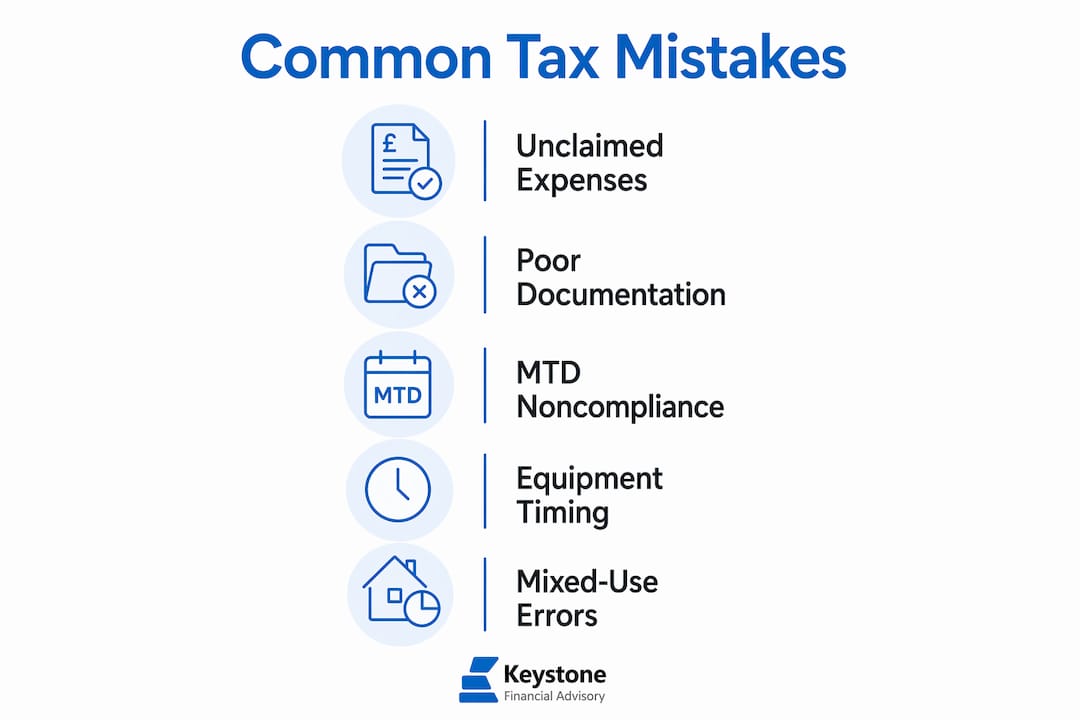
Claiming suits as clinical attire. Basic business clothing, including suits worn at practice, is disallowed. Only clothing that cannot be worn outside a clinical setting qualifies. Scrubs pass this test. A navy suit does not.
Missing mixed-use apportionment. Vehicles, mobile phones, and home offices used for both personal and professional purposes require a business-use calculation. Many dentists either claim nothing or claim 100%, both of which invite HMRC scrutiny.
Misclassifying CPD. Training linked to current practice is deductible. Training that creates a new income stream is not. The distinction matters and requires documentation.
VAT errors on cosmetic treatments. Clinical dental services are VAT-exempt. Cosmetic treatments such as teeth whitening are standard-rated for VAT. Practices offering both must apportion correctly. Misclassification leads to unexpected liabilities and HMRC disputes.
No documentation trail. HMRC does not accept verbal explanations. Every deduction needs a receipt, invoice, or mileage log that links the cost to a business purpose.
Pro Tip: For mixed-use expenses, calculate your business-use percentage once per year using a representative sample period, then apply it consistently. Document the methodology. HMRC accepts a reasonable, evidenced approach.
How can dentists get the most from their tax relief options?
Claiming what you are owed is one thing. Structuring your finances to maximise those claims is another. Several strategies make a material difference.
Capital allowances and equipment timing
Capital allowances on dental equipment let you deduct the cost of chairs, X-ray units, and practice fit-outs against taxable profits. The Annual Investment Allowance (AIA) provides 100% relief in the year of purchase up to its current threshold. Timing a major equipment purchase before your year-end accelerates the deduction.
Pension contributions
Pension contributions reduce taxable income directly. For dentists operating through a limited company, employer pension contributions are a corporation tax deduction and do not attract National Insurance. Strategic pension planning is one of the most tax-efficient tools available to dental professionals, yet it is consistently underused.
Income and expense timing
Dentists with some control over invoice timing can smooth taxable profits across tax years. Bringing forward deductible expenses into a high-income year, or deferring income where possible, reduces the peak tax charge. This requires planning, not last-minute adjustments.
When to bring in a specialist
General accountants rarely know the nuances of dental VAT, GDC fee deductibility, or NHS contract income treatment. A dental tax specialist understands these distinctions and can identify reliefs that a generalist would miss. The fee for specialist advice is itself a deductible expense.
Key takeaways
UK dentists who document expenses thoroughly, comply with MTD from the 2026/27 tax year, and plan pension and equipment purchases strategically will pay significantly less tax than those who do not.
Point | Details |
Clinical attire and laundering | Scrubs, gowns, and cleaning costs are fully deductible; suits are not. |
MTD quarterly reporting | Dentists earning over £50,000 must submit digital quarterly updates from april 2026. |
CPD deductibility | Only courses updating existing skills qualify; new specialisation training may be disallowed. |
VAT on cosmetic treatments | Cosmetic services are standard-rated; clinical services are exempt. Mixing both requires careful apportionment. |
Pension contributions | Employer pension contributions through a limited company reduce corporation tax and carry no National Insurance charge. |
What I have seen dentists leave on the table
The reliefs that cost dentists the most are not the complicated ones. They are the mundane ones that nobody bothers to track. Clinical attire cleaning is the clearest example. Every dentist washes their scrubs. Almost none of them claim it. Over a career, that is a meaningful sum.
The MTD shift worries a lot of practitioners I speak to, but it should not. Quarterly reporting forces the discipline that good tax planning already requires. Dentists who start categorising expenses monthly now will find the 2026 deadlines straightforward. Those who wait will scramble.
The bigger picture is this: tax reliefs are not a bonus. They are part of your income. Leaving them unclaimed is no different from leaving money in the practice at the end of the month and walking away from it. The documentation burden is real but manageable. The reward is consistent and compounding.
If you are unsure whether a specific cost qualifies, the default answer is to document it and ask a specialist. The cost of the question is always less than the cost of missing the deduction.
— Shoaib
How KeystoneFA helps UK dentists claim every relief they are owed
KeystoneFA works with dental professionals across the UK to identify every allowable deduction, from GDC fees to mixed-use vehicle apportionment. The team understands the specific tax treatment of NHS and private income, cosmetic VAT classification, and the 2026 MTD quarterly reporting requirements.
[
KeystoneFA’s tax consultation service covers a full review of your current claims, a gap analysis against HMRC-allowable categories, and a practical plan for MTD compliance. Whether you are a sole practitioner or running a group practice, the approach is tailored to your income structure. Book a consultation with the KeystoneFA team and find out exactly what you have been missing.
FAQ
What expenses can a dentist claim as tax relief in the UK?
Dentists can claim GDC fees, indemnity insurance, clinical attire and laundering costs, CPD courses linked to current practice, laboratory fees, business mileage, and digital practice tools. Each cost must be wholly and exclusively for professional purposes.
When does Making Tax Digital apply to dentists?
MTD for Income Tax Self Assessment applies to self-employed dentists earning over £50,000 from the 2026/27 tax year. The first quarterly submission deadline is 7 august 2026.
Can dentists claim tax relief on CPD training?
CPD that updates existing clinical skills is fully deductible. Training for an entirely new specialisation may be treated as capital expenditure and disallowed, so documentation linking the course to current practice is essential.
Are cosmetic dental treatments subject to VAT?
Cosmetic treatments such as teeth whitening are standard-rated for VAT, while clinical dental services are exempt. Practices offering both must apportion income correctly to avoid HMRC disputes.
Is a dentist’s suit tax deductible?
No. Standard business clothing, including suits, does not qualify. Only clinical wear that cannot reasonably be worn outside a professional setting, such as scrubs and surgical gowns, is deductible.
Recommended