Director's loan accounts: how to avoid HMRC charges

TL;DR:
A director’s loan account is a record of money transferred between a director and their company outside salary or dividends. Overdrawing the account beyond nine months and one day after year-end triggers a 33.75% tax, which must be repaid to avoid penalties. Proper management, timely repayments, and correct coding help directors prevent HMRC charges and ensure compliance.
A director’s loan account (DLA) is the official bookkeeping record of all money transferred between a director and their limited company outside of salary, dividends, or legitimate expense reimbursements. Get it wrong, and HMRC can charge your company 33.75% tax on the outstanding balance. Understanding director’s loan accounts and how to avoid HMRC charges is not optional for limited company directors. It is a core compliance requirement that directly affects your Corporation Tax bill.
What is a director’s loan account and how does it work?
A director’s loan account is a bookkeeping record that reflects the running balance between you and your company. Every time you take money from the company that is not salary or a declared dividend, it is recorded as a debit to your DLA. Every time you put money in, or the company owes you for expenses, it is recorded as a credit.
The account can sit in two states:
Credit balance: the company owes you money. This happens when you have lent money to the company or paid business costs personally.
Overdrawn balance: you owe the company money. This is the state that triggers HMRC’s attention and potential tax charges.
Common transactions that affect a DLA include personal purchases made on the company card, cash withdrawals not coded to salary, and dividend adjustments when a declared dividend exceeds available reserves. Misclassifying withdrawals or blending personal and business expenses in company accounts often causes unexpected overdrawn balances. Keeping transactions clearly coded at the point of entry prevents those surprises at year end.
Pro Tip: Assign a dedicated nominal code in your accounting software specifically for DLA transactions. This makes it far easier to run a balance report at any point during the year, rather than discovering a problem when your accountant prepares your statutory accounts.

How does the Section 455 tax charge apply to overdrawn DLAs?
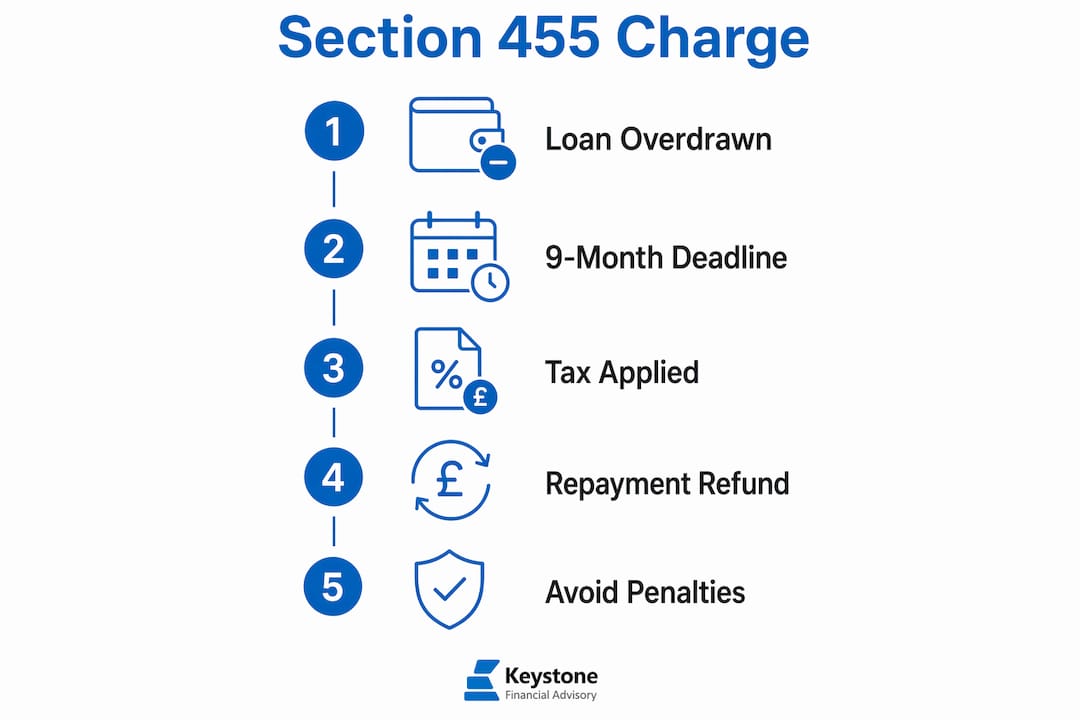
The Section 455 charge is a 33.75% tax levied on any overdrawn director’s loan balance that remains unpaid nine months and one day after your company’s financial year end. It is reported on the CT600A supplementary page of your Corporation Tax return and is due at the same time as your Corporation Tax payment.
The charge is not permanent. It is refundable once you repay the loan. However, the refund process requires your company to apply to HMRC using form L2P. Refunds typically become available nine months after the year end in which repayment occurs. That lag creates a real cash flow problem for many directors.
Here is a simple illustration of how the charge works:
Scenario | Overdrawn DLA balance | Section 455 charge at 33.75% |
Small withdrawal not repaid | £10,000 | £3,375 |
Larger unplanned borrowing | £30,000 | £10,125 |
Significant overdrawn balance | £50,000 | £16,875 |
The figures above show why timing matters. Repaying the overdrawn DLA balance within nine months and one day of your year end avoids the charge entirely. Missing that deadline means your company pays a substantial sum upfront, then waits months to recover it.
What anti-avoidance rules does HMRC apply to director’s loans?
HMRC does not allow directors to sidestep the Section 455 charge by repaying a loan just before the deadline and then immediately reborrowing. This practice is known as “bed and breakfasting.” HMRC’s anti-avoidance rules treat any repayment of £5,000 or more followed by a reborrow within 30 days as if the repayment never happened. The Section 455 charge applies as though the loan remained outstanding.
Benefit-in-kind charges add another layer of risk. Loans exceeding £10,000 trigger a taxable benefit in kind if the company does not charge interest at least equal to HMRC’s official rate. For 2026/27, that rate is 2.25%. Loans below £10,000 are exempt from this charge, but once you cross that threshold, both you and the company face additional tax obligations.
Directors sometimes confuse loan repayments with dividend declarations. These are legally distinct. A dividend requires a board resolution and sufficient distributable reserves. You cannot simply reclassify a loan as a dividend after the fact to clear the balance. HMRC treats that as a misclassification, and it can lead to penalties on top of the original charge.
Pro Tip: Never repay a large DLA balance close to the nine-month deadline if you plan to withdraw similar funds shortly afterwards. HMRC will apply the 30-day rule and the Section 455 charge will stand. Plan your cash flow so repayments are genuine and final.
What practical steps reduce your risk of HMRC penalties?
Managing your DLA proactively is far less costly than dealing with a Section 455 charge after the fact. These steps give you a clear framework:
Set a calendar reminder for nine months after your company year end. That is your hard deadline for repaying any overdrawn balance without triggering a charge.
Separate personal and business expenses at the point of entry. Accurate expense coding is the single most effective way to prevent an unintended overdrawn balance.
Use dividends to clear overdrawn balances where possible. Declaring dividends with a proper board resolution and sufficient distributable reserves is tax-efficient and legally sound.
Avoid repaying then reborrowing amounts of £5,000 or more within 30 days. The 30-day anti-avoidance rule will nullify the repayment for Section 455 purposes.
Charge interest at the HMRC official rate on any loan balance above £10,000. For 2026/27, that rate is 2.25%. This avoids a benefit-in-kind charge on both you and the company.
Review monthly management accounts that include your DLA balance. Real-time DLA monitoring allows you to take corrective action before year end rather than after.
Engage a professional accountant to prepare your statutory accounts and Corporation Tax return. Errors in coding or timing can result in charges that a qualified adviser would have prevented.
For a broader view of tax-efficient withdrawals from your limited company, understanding how salary, dividends, and loans interact is worth reviewing alongside your DLA position.
Key takeaways
A director’s loan account becomes a tax liability the moment it stays overdrawn past nine months and one day after your company year end. Proactive monitoring, correct coding, and timely repayment are the only reliable ways to avoid Section 455 charges.
Point | Details |
Section 455 charge rate | HMRC charges 33.75% on overdrawn DLA balances unpaid after nine months and one day. |
Refund process | Companies reclaim overpaid S455 tax via form L2P, but refunds take months to arrive. |
Bed and breakfasting rule | Repaying and reborrowing £5,000 or more within 30 days does not clear the Section 455 liability. |
Benefit-in-kind threshold | Loans above £10,000 require interest at 2.25% (2026/27 rate) to avoid a taxable benefit charge. |
Best avoidance method | Monthly DLA reviews and timely dividend declarations prevent charges before they arise. |
Why I think most directors underestimate their DLA risk
Working with limited company directors across a range of sectors, I see the same pattern repeatedly. The DLA is treated as an afterthought until the accountant flags a problem at year end. By that point, the nine-month window may already be closing, and the options are limited.
The directors who avoid Section 455 charges are not necessarily the ones with the smallest loan balances. They are the ones who review their DLA monthly, plan dividend declarations in advance, and understand that the account is a live financial obligation, not just a line in the annual accounts. Cash flow is the hidden cost here. Even if you eventually reclaim the S455 tax, your company has paid it upfront and waited months for a refund. That is real money tied up unnecessarily.
My advice is to treat your DLA the same way you treat your VAT position: check it regularly, act before deadlines, and get professional input before problems compound. The business records you keep throughout the year determine how much control you have at year end.
— Shoaib
How KeystoneFA helps directors stay ahead of HMRC
Managing a director’s loan account correctly requires more than good intentions. It requires accurate bookkeeping, timely dividend planning, and a clear understanding of Corporation Tax deadlines.
[

KeystoneFA works with UK limited company directors to keep DLA balances monitored, coded correctly, and resolved before HMRC charges arise. From tax consultation to full statutory accounts preparation, the team brings hands-on experience with HMRC compliance for founders and growing businesses. If your year end is approaching and you are unsure about your DLA position, book a consultation and get clarity before the deadline passes.
FAQ
What is a director’s loan account?
A director’s loan account is a bookkeeping record of all money transferred between a director and their limited company that falls outside salary, dividends, or expense reimbursements. It shows whether the company owes the director money or the director owes the company.
When does the Section 455 charge apply?
The Section 455 charge applies when an overdrawn director’s loan balance remains unpaid nine months and one day after the company’s financial year end. HMRC charges 33.75% on the outstanding balance at that point.
Can I repay my director’s loan and then borrow again?
Repaying and reborrowing £5,000 or more within 30 days triggers HMRC’s bed and breakfasting anti-avoidance rule. HMRC treats the repayment as if it never happened, and the Section 455 charge still applies.
How do I avoid benefit-in-kind charges on a director’s loan?
Charge interest at or above HMRC’s official rate, which is 2.25% for 2026/27, on any loan balance above £10,000. Loans below £10,000 are exempt from benefit-in-kind charges entirely.
Can I use a dividend to clear an overdrawn director’s loan account?
Yes. Declaring a dividend with a proper board resolution and sufficient distributable reserves is a tax-efficient way to clear an overdrawn DLA. The dividend offsets the loan balance and reduces or eliminates the Section 455 exposure.
Recommended